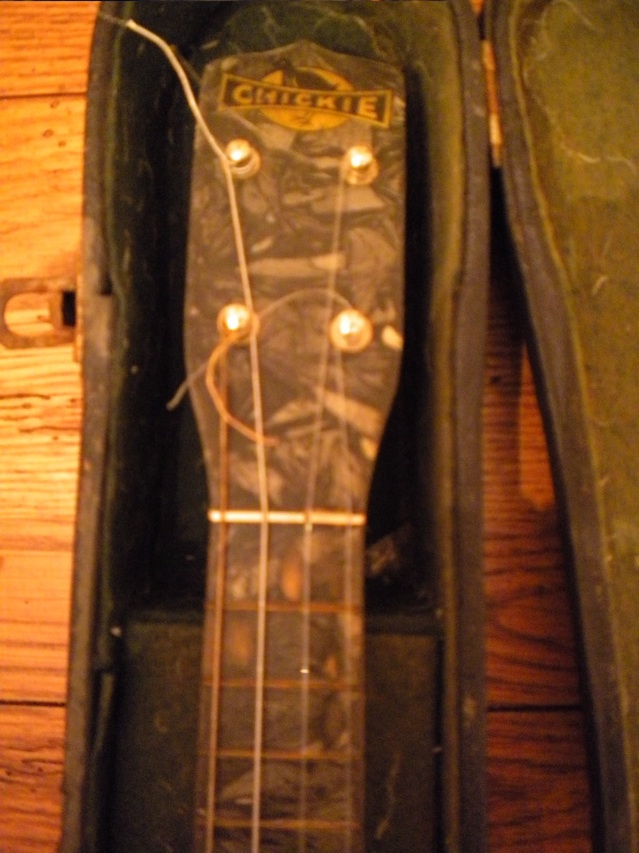
Question: Hi, I bought an old uke years back. It is called a Chickie. The label says made in Chicago. How old is it and do you know anything about its history?
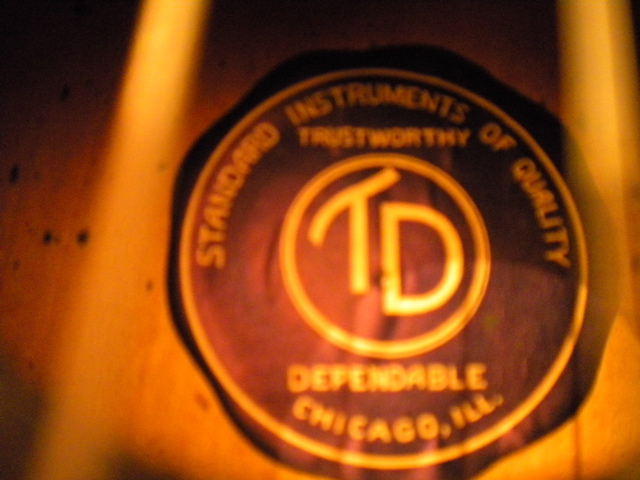
Answer: That's a great ukulele you have — very unusual. I have never seen another "Chickie" brand ukulele — I don't think a whole lot of them were sold. I am guessing that the TD on the label stands for "Targ and Dinner". Targ and Dinner was a large musical instrument distributor based in Chicago. They distributed instruments from many different manufacturers, so it is a bit harder to name a particular manufacturer. Chickie was likely a Targ and Dinner brand. The finish is what was referred to as a "Crystal" finish in its day. This type of finish was popular on inexpensive instruments in the 1930s. Also, it looks like a pretty nice hard-shell case it is in.
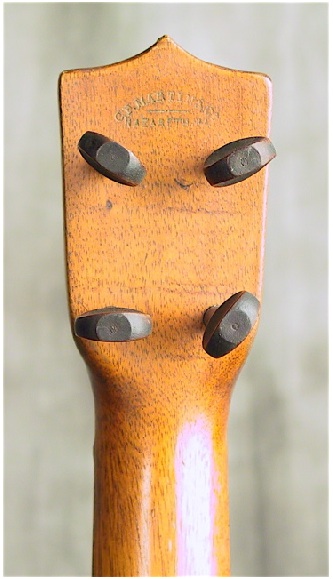
Question: I have already bought it but it hasn't been sent yet, but I would like to know this ukulele's information. I saw many websites which have many photos about Martin ukulele, but I saw them example pictures, the standard Martin koa ukuleles fingerboard are using rosewood or mahogany, so I think this one a little bit unusual, maybe you could help me more understand this ukulele. Thank you a lot.
Answer: That's a nice old Martin Style 2K you are getting. You are correct that it is an unusual model. This looks to be a very early Style 2K. Martin first produced 2K ukuleles in 1919. Most were made for the Southern California Music Company, and were stamped on the back of the headstock with the Southern California Music Company stamp. So it is interesting to see such an early one with a Martin stamp on it. Another sign that it is a very early Martin is that the position markers are on the 5th, 7th, and 9th frets. The koa wood (?) fingerboard is definitely very early and unusual.
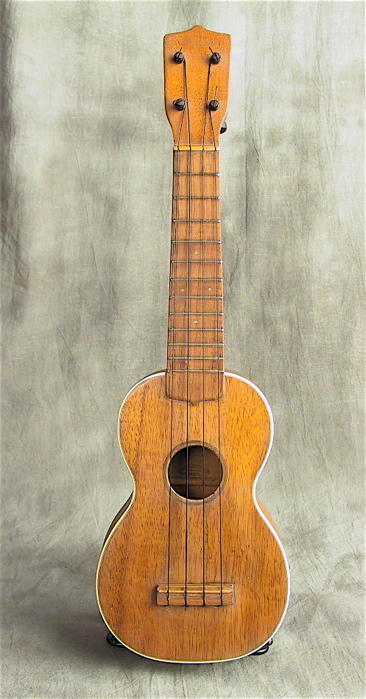
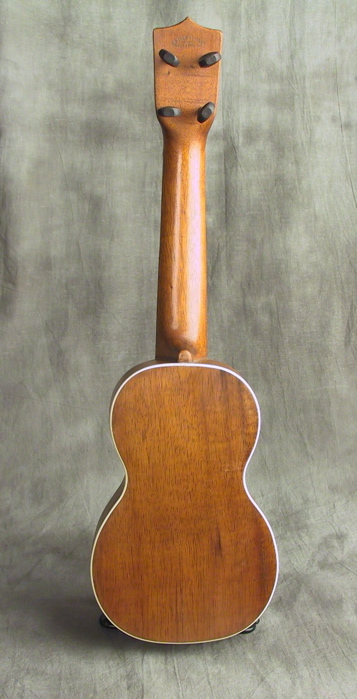
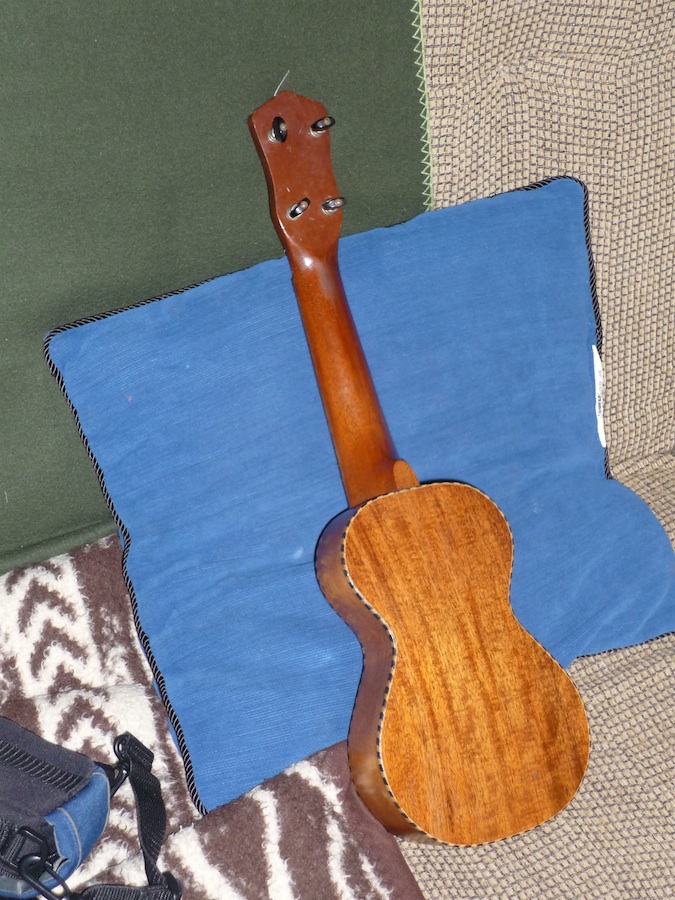
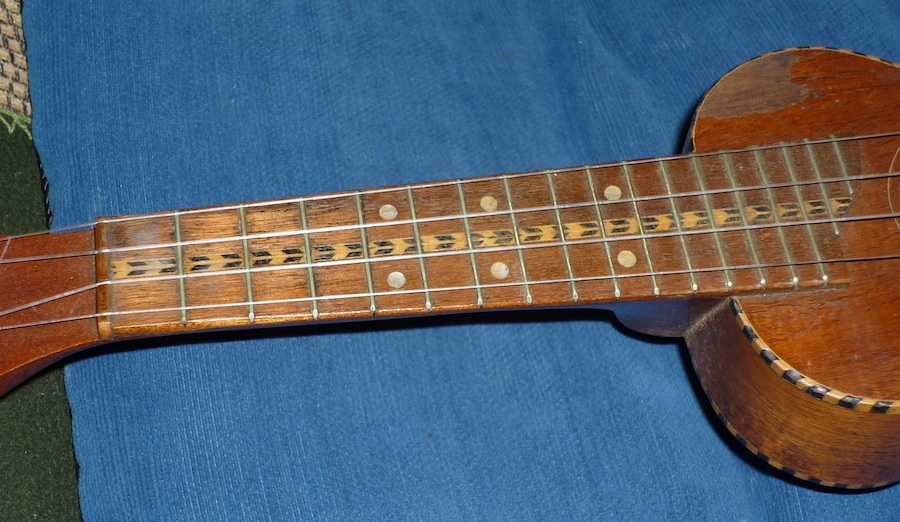
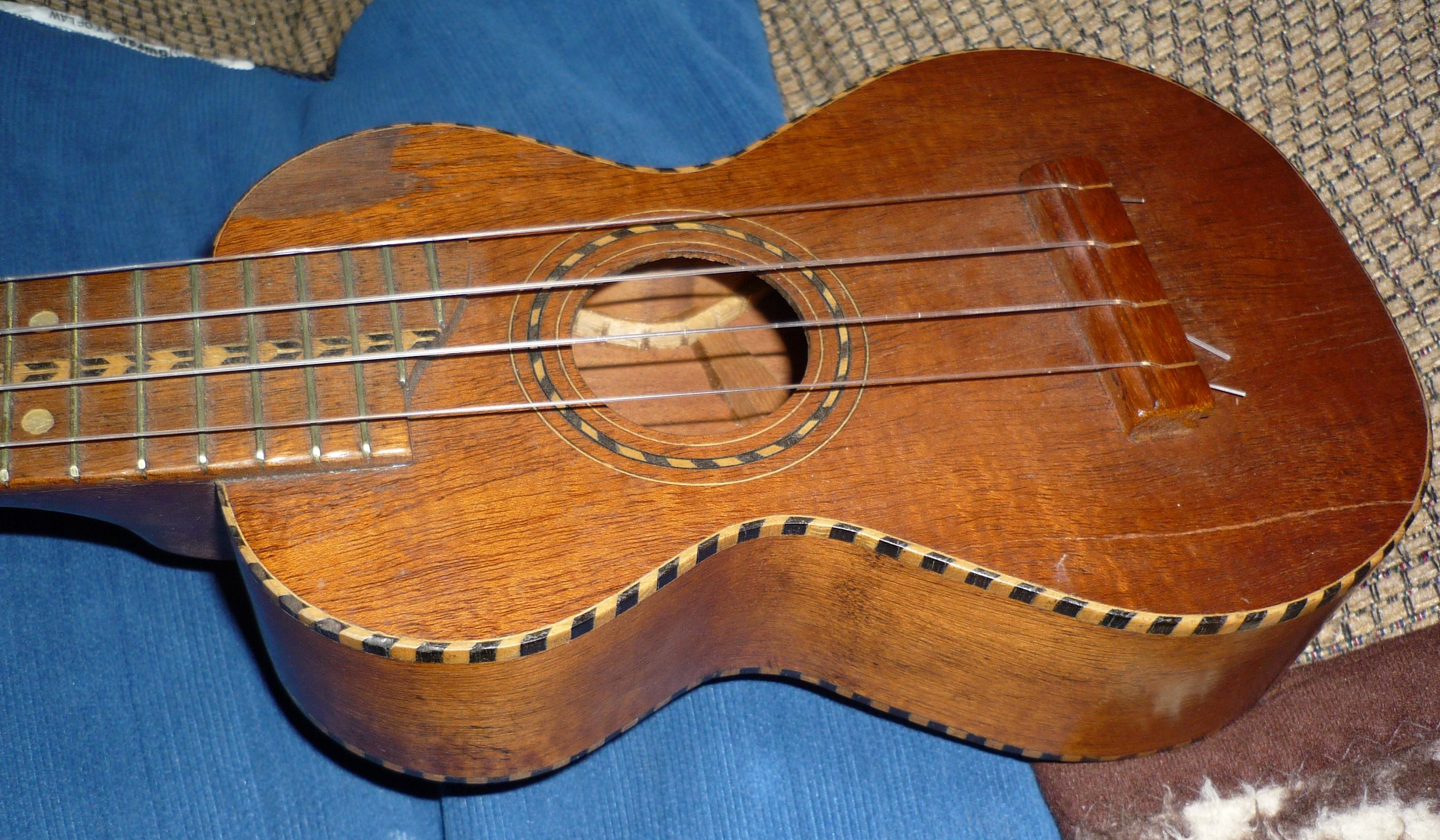
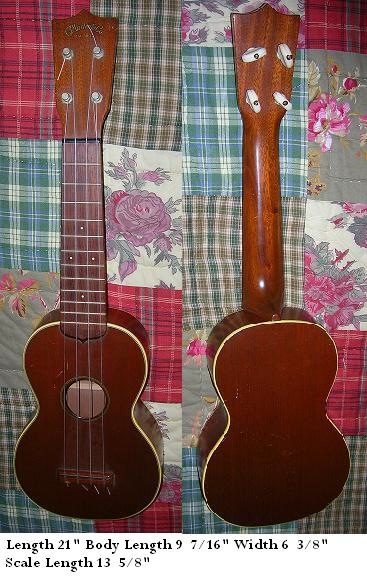
Question: The mystery uke is photographed above. It seems to be very well made. Grover tuners. Judging by the case, I'm assuming it's also late 40's, early 50s. There is no brand name on it anywhere that I can find. Any info would be greatly appreciated.
Answer: Your "mystery" uke was made by the Harmony Company of Chicago, Illinois. It is likely from the 1920s, and it is made to look like a Hawaiian-made ukulele. I can't tell if it is Hawaiian koa wood or mahogany — I'd guess koa but it is hard to say for sure from your photos. This was a high-end ukulele for Harmony, with the fancy bindings and fretboard inlay. The tuning pegs are high end Grovers — they may be original or may have been replaced long ago.
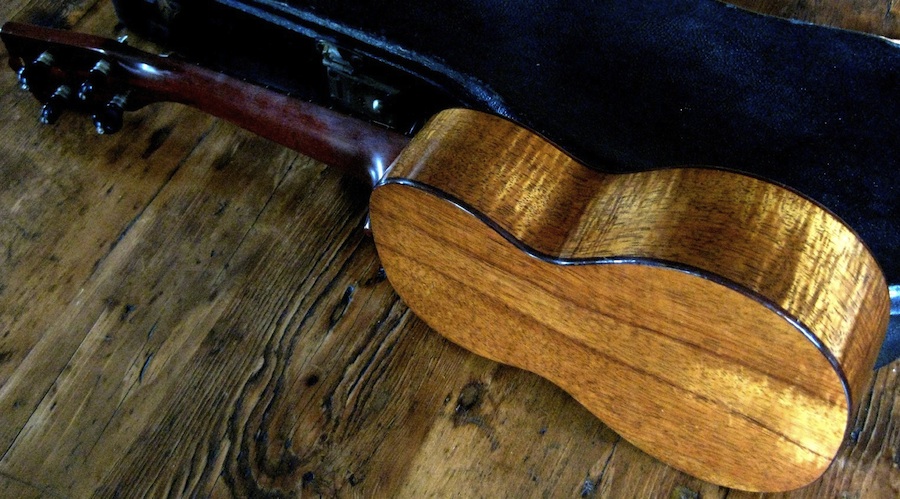
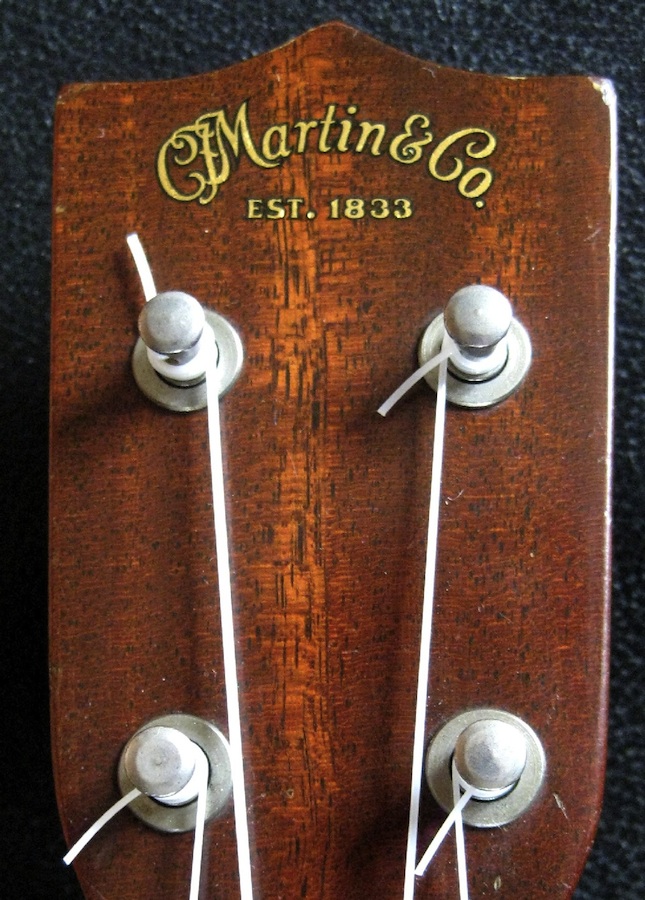
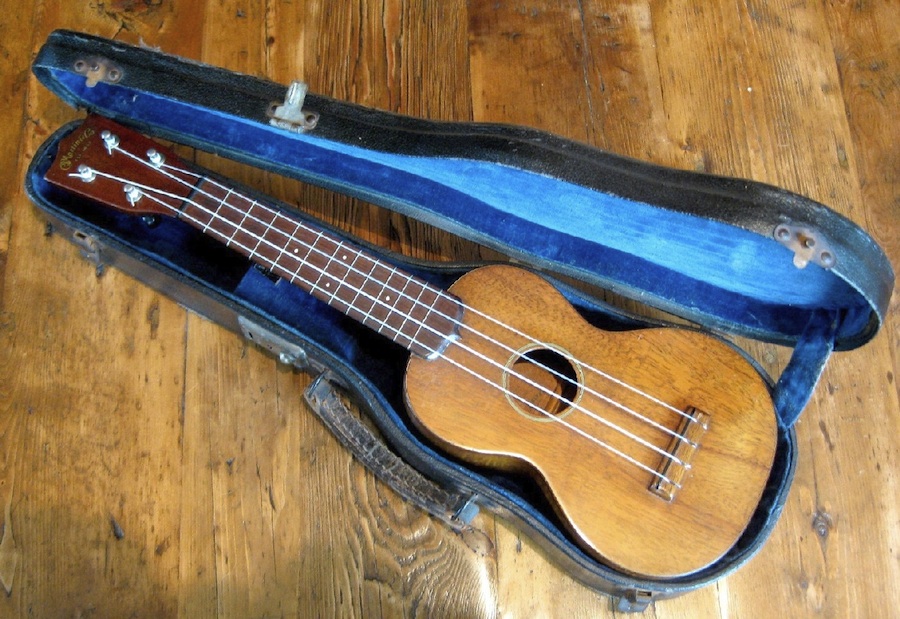
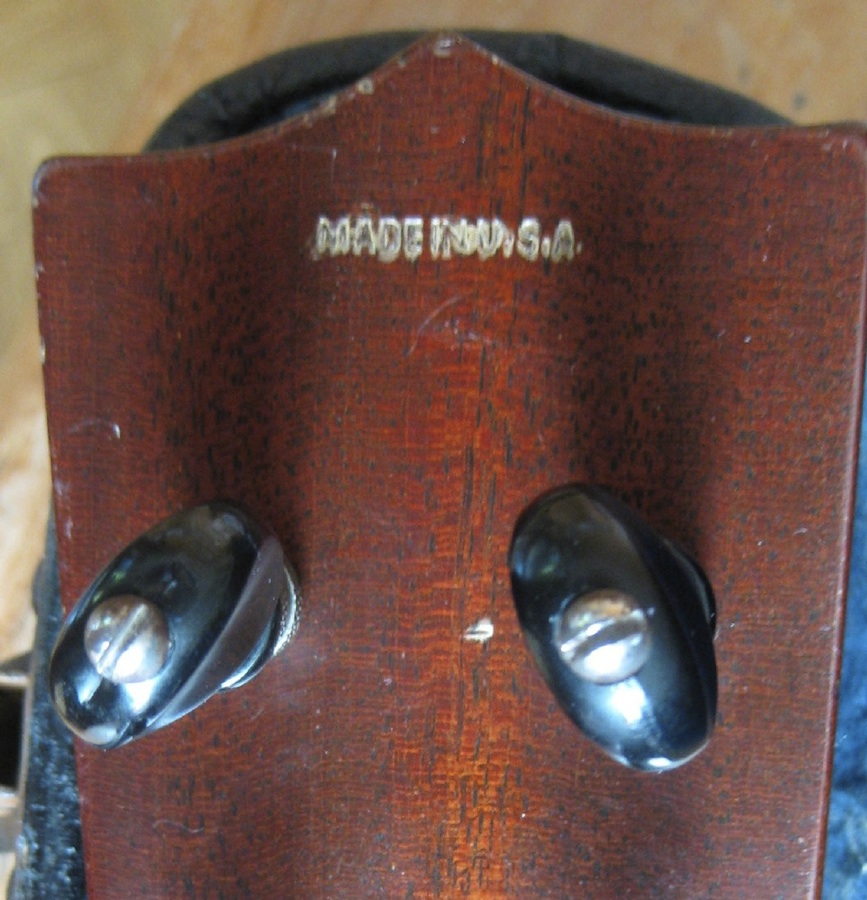
Question: Hello, I own a 1930's Martin 2K soprano Ukulele. It has the decal on the front and bar frets, it also has rosewood binding rather than the more common cream or white. Made in the USA is also stamped on the back of the peg head. I have been told that this means that it was for export, is this true? Many thanks.
Answer: Your ukulele is actually a Style 1K not a Style 2K. As you mentioned, the 2K had ivory colored binding, while the 1K from that period had rosewood binding. I'd guess your ukulele is from the mid to later 1930s with its combination of features. It is true that the Made in USA stamp was used on instruments that were being exported.
Question: Dear ʻUkulele Hall of Fame, Here is an all koa wood soprano ukulele made for the mainland department store, Rhodes Brothers (in Tacoma, Washington, established in 1892). Their label reads, "Rhodes Bros. / Incorporated / Hawaiian Ukulele Dealers / Tacoma, / Wash". I'm hoping you might be able to supply more information about this instrument's date of manufacture and possibly its maker? The construction characteristics may give up some clues: it has a one piece koa wood rib and an arched back. It's a great player! Thank you for your website and this tremendous service!!
Answer: That's a nice ukulele you have — I actually own a pretty similar one that I am guessing was made by the same company. Your ukulele has strong Hawaiian characteristics including the style of neck construction, the Hawaiian koa wood body, and the rope style binding. I think most people would tell you it is Hawaiian-made. Still, I believe your ukulele is actually an early mainland-made ukulele. As ukulele popularity grew in California in the teens, a few manufacturers went into business around California. Some of these California makers produced ukuleles very similar in style and construction to the true Hawaiian makers. I'm guessing your ukulele was made by one of the California manufacturers around 1914–1920. I assume the California manufacturers died out when Chicago companies started to mass-produce cheaper ukuleles.
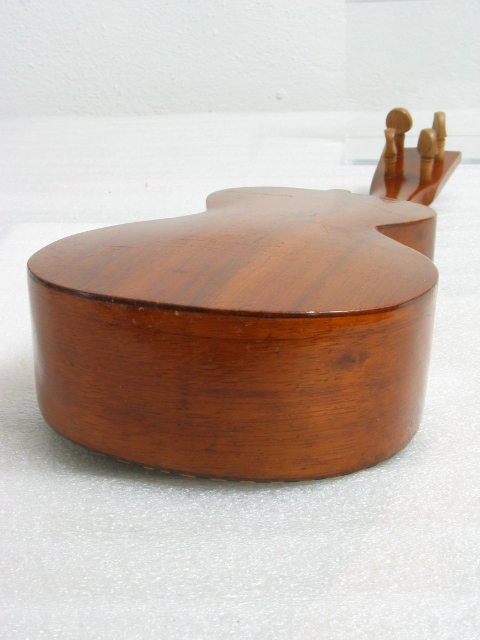
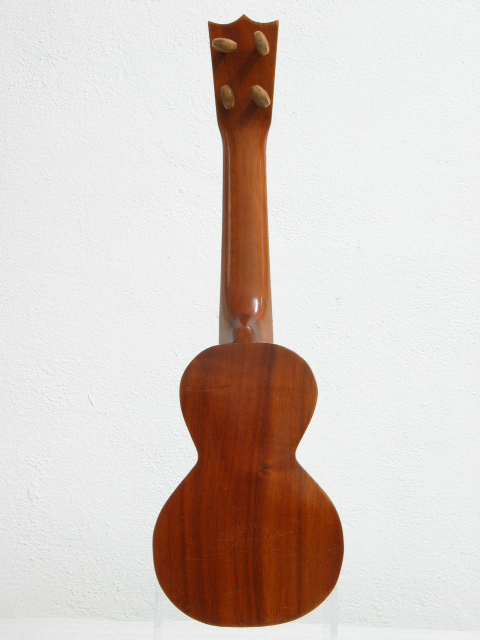
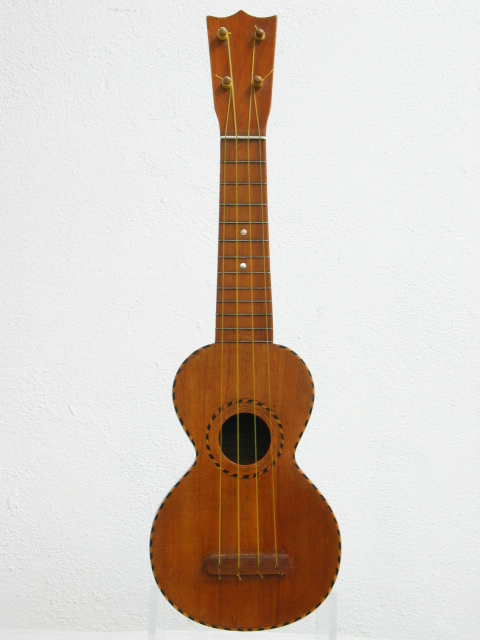
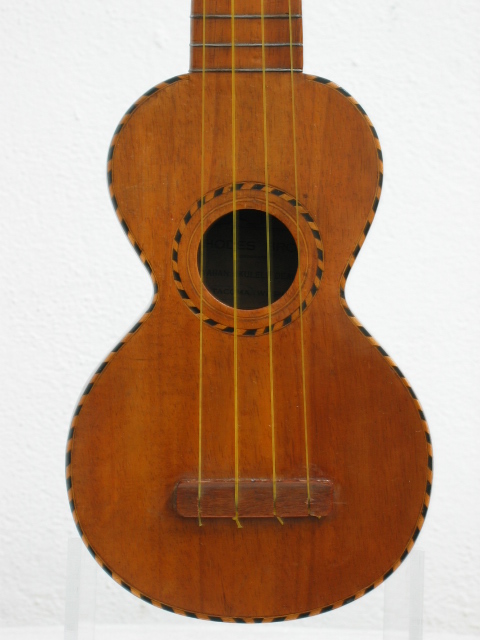
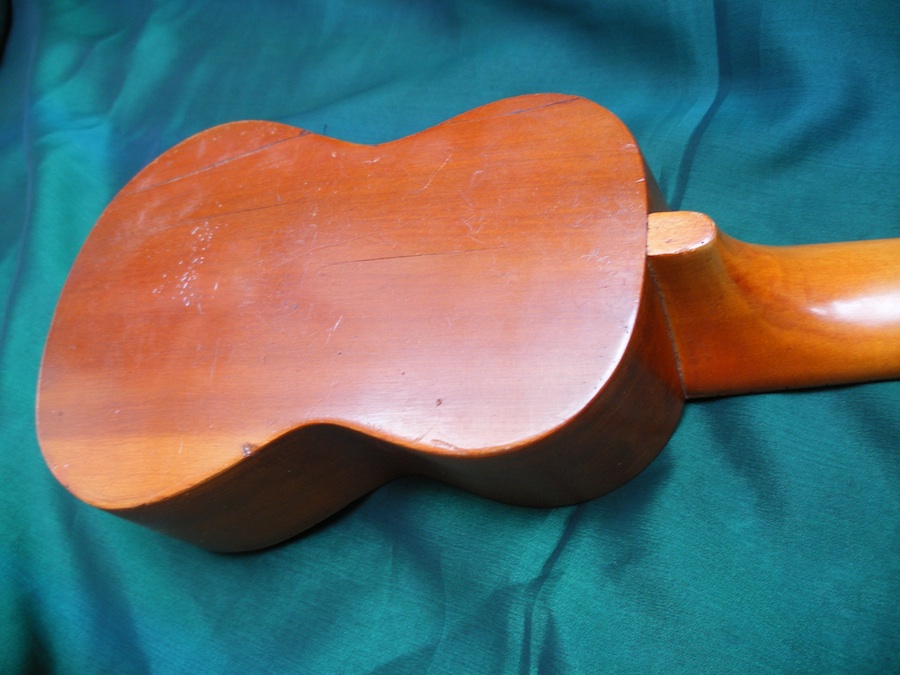
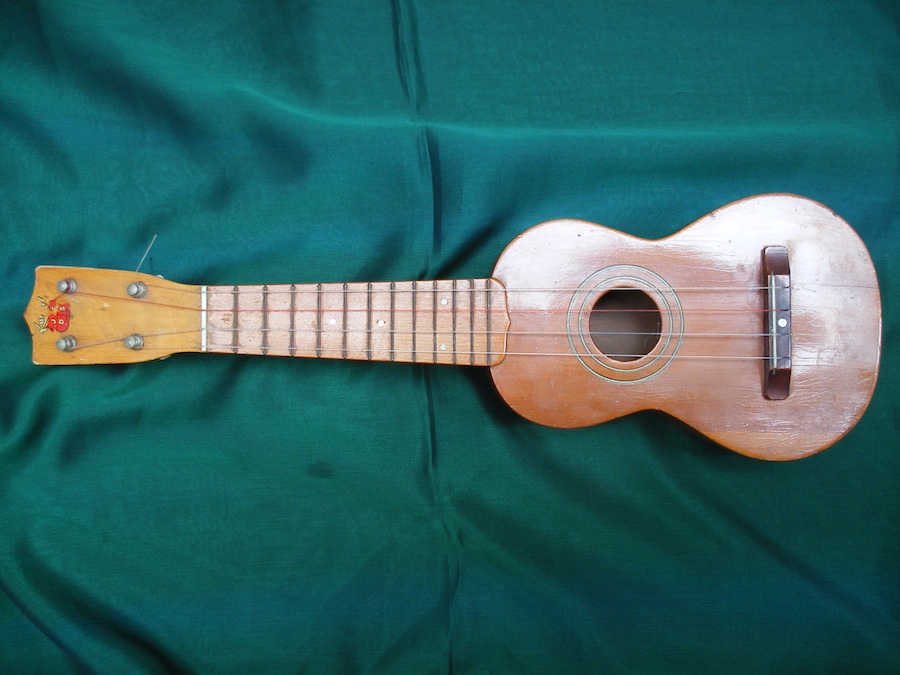
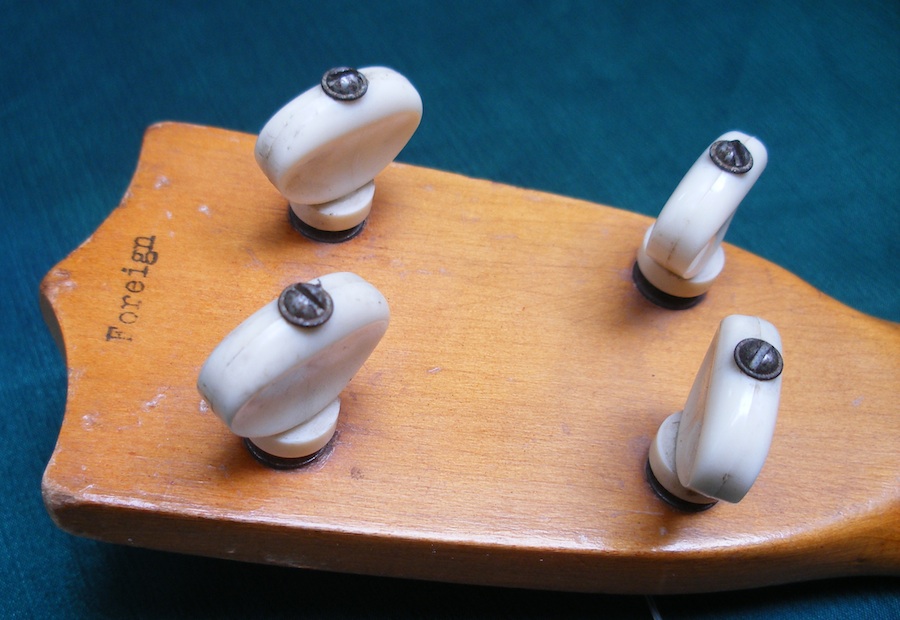
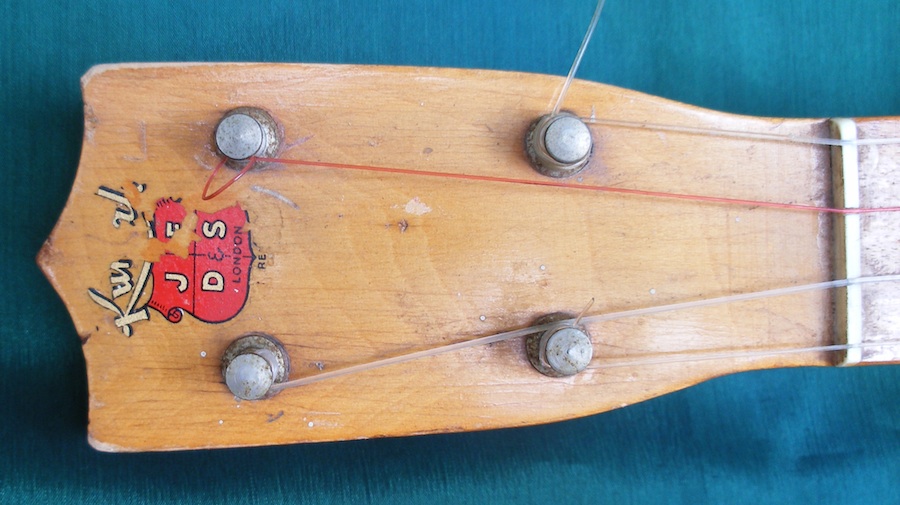
Question: New to the world of ukes, I'm a guitar player. I have been on the lookout for one for a while now. Bought this last week in a car boot sale in London and would love to find out more about it. Someone (over the phone) thought it was a Kumalae but didn't recognise the red shield label. Any info highly appreciated. Thanks.
Answer: Thanks for the photos. Your ukulele looks like an early Japanese-made ukulele to me. I can't say for sure it is Japanese, but I'm quite sure it was not made in the US or Hawaii. Definitely not a Kumalae (or other Hawaiian maker). I'd guess it was made in the late forties or early 1950s. I am not familiar with the headstock decal, but I guess it was applied by the London distributor that sold it. Sorry I don't have more info.
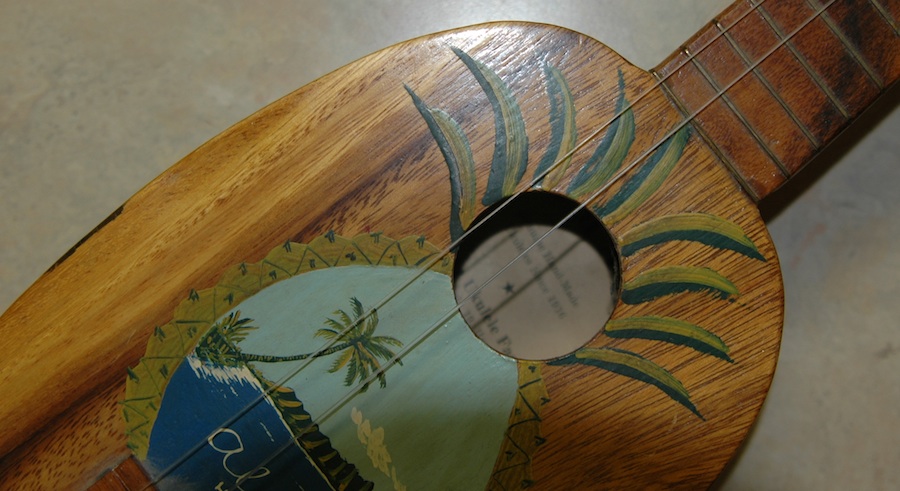
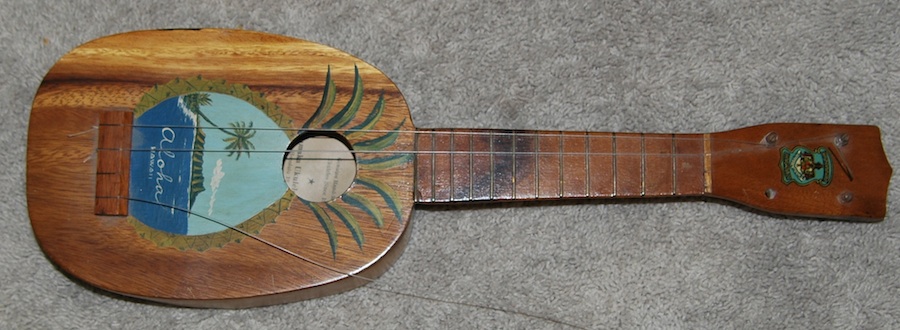
Question: Could you please help me identify this Ukulele. I was a child when my uncle gave it to me. He was in Hawaii in the 40's. I would like to know as much about it as you can tell me. I have searched the internet and have not seen another one like this. Thank You.
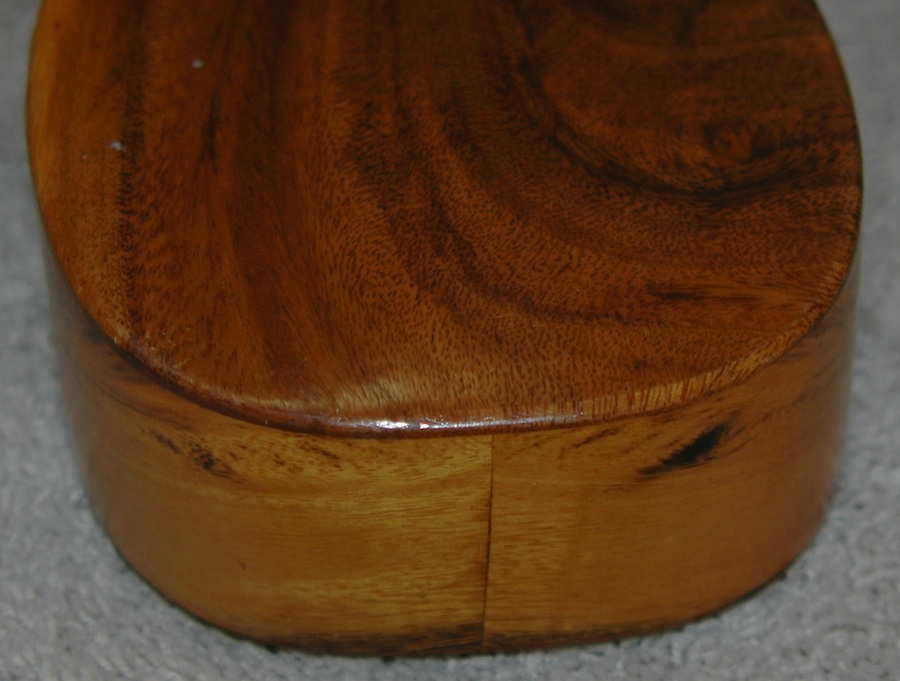
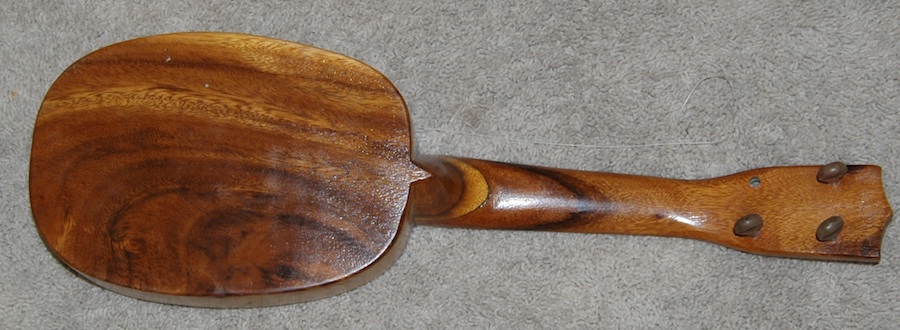
Answer: That is a very interesting ukulele you have. This looks like a late 1930s or early 1940s Kamaka pineapple ukulele. The wood appears to be monkey pod not koa. The painting on the top is what makes it unusual. I have seen other styles of painting on Hawaiian ukuleles from this period, but never one quite like yours. I would guess these were hand-painted by someone and sold as souvenirs. The painting on your ukulele is nicely done and I think it is quite attractive.
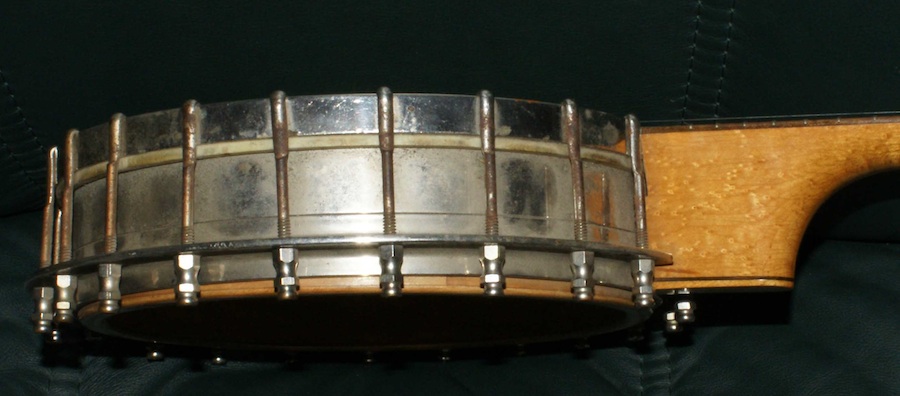
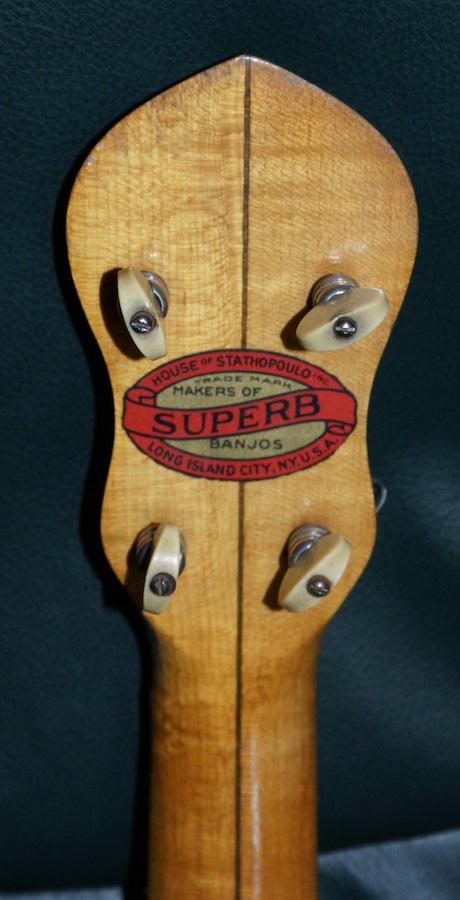
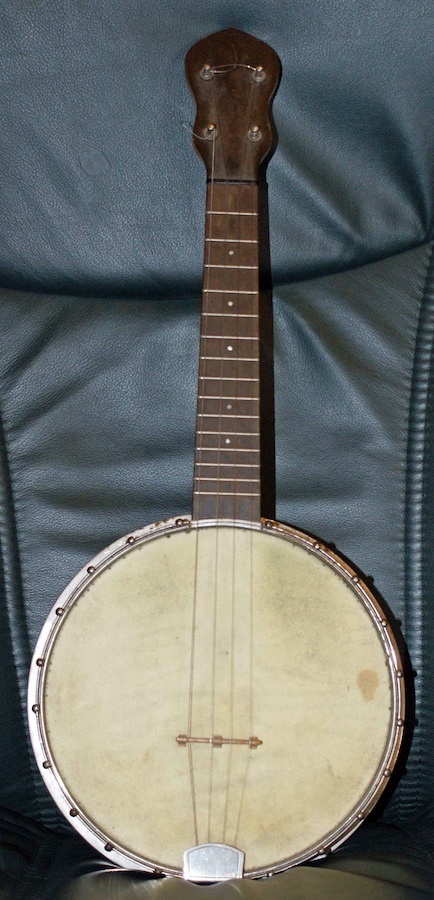
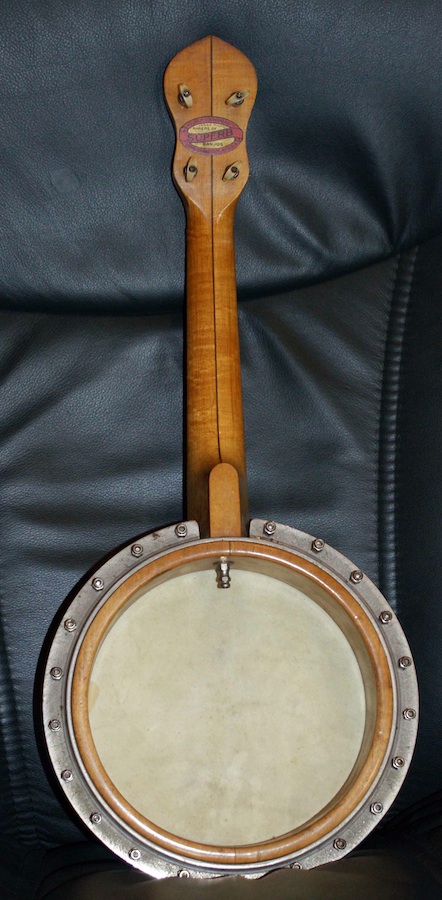
Question: This banjo uke was given to me because I am a banjo player. I haven't cleaned it up yet but am interested in what you can tell me about the instrument. I have never heard of the maker. The neck appears to be maple and is very solidly attached. Action excellent. It currently has metal strings (is this usual?) and is tuned to an open chord (like a 5-string banjo G tuning). Is this correct? Since I have not heard one of these things played, I am not sure what kind of music one might attempt (other than loud). Any pointers appreciated. PS: Great website!!
Answer: The instrument in your photos is a banjo ukulele made by The House of Stathopoulo, known later as Epiphone. The company was run by Epi A. Stathopoulo. They made very good quality banjos, banjo mandolins, and banjo ukuleles. Banjo ukuleles were typically played (and strung) like standard ukuleles, but they were usually louder. Gut strings would have been the standard when this was made, today nylon strings are the standard. The standard ukulele tuning is GCEA (or sometimes ADF#B), with the G string tuned re-entrant (the strings don't go from highest to lowest pitch in order). George Formby is probably the best known banjo-ukulele player. You can check out his playing by doing a quick search on Youtube.
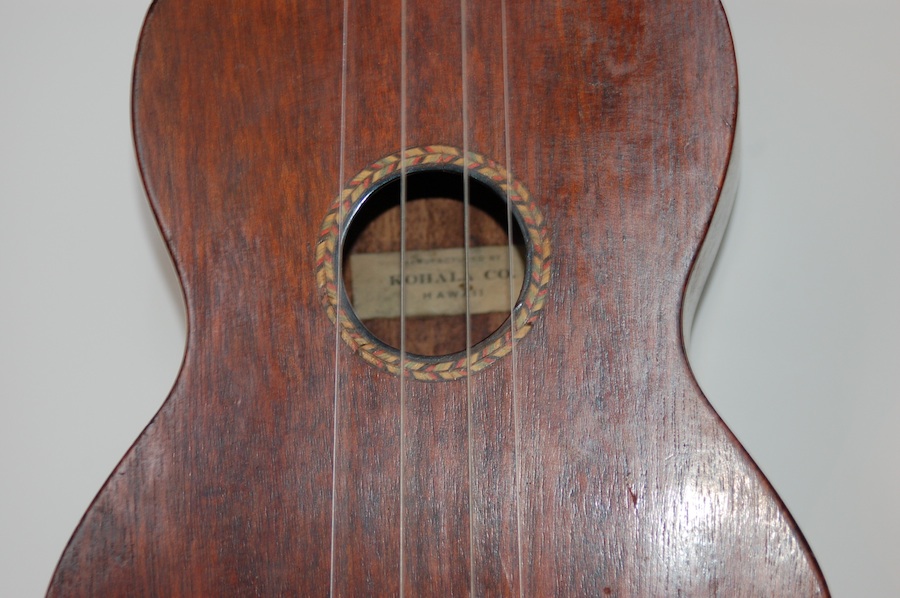
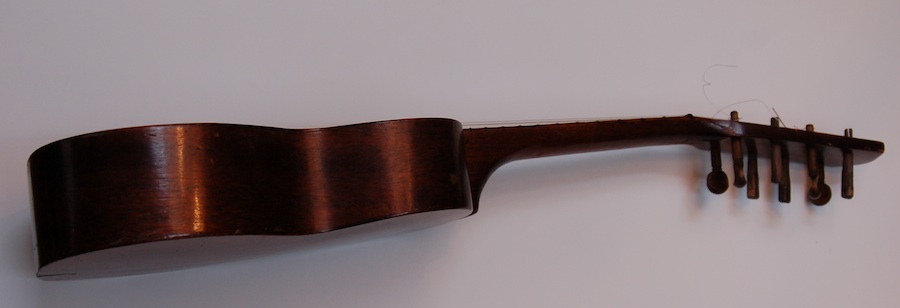
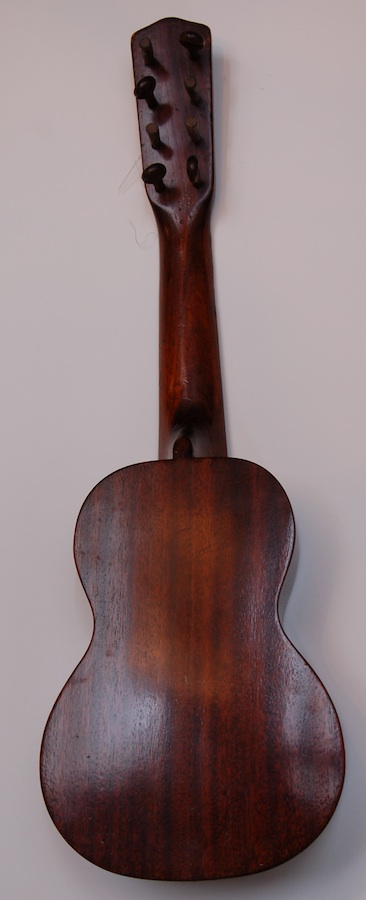
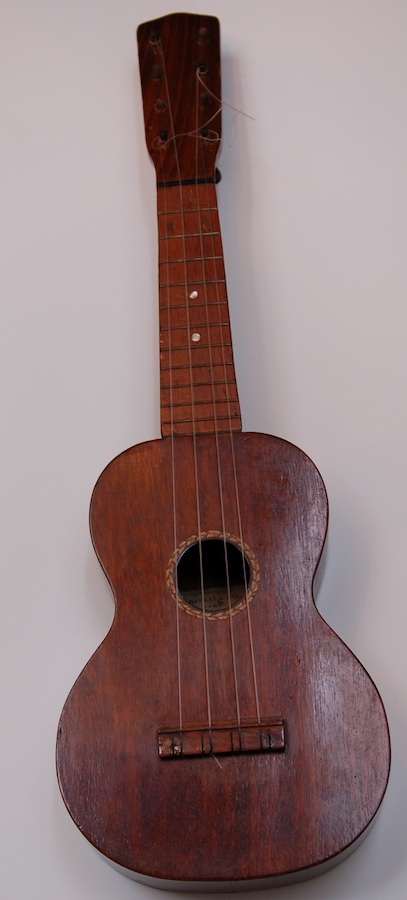
Question: Any information about this 8 string (soprano?) ukulele would be appreciated. It was my father's, who recently carved new pegs to replace missing ones. The interior label reads: manufactured by KOHALA CO. Hawaii. The soundhole is surrounded by white, red, green and black inlay. I am just starting to learn to play it. If I get the 2nd set of strings, how is it tuned, and do you need to buy a different type of string if notes are an octave apart? Thank you so much.
Answer: Your eight string ukulele is known as a taropatch. Taropatches were popular from the later teens through around 1930. I would guess yours is from around the mid 1920s. It looks to be a product of the Regal Co. Regal was one of the big Chicago ukulele manufacturers of the time. Regal was the only ukulele company that I know of that was using the multi-colored herringbone inlay, so I'm pretty sure they made your instrument. The Kohala label was probably added by the retailer. Hawaiian ukuleles had a better reputation than those made on the mainland, so many times deceiving labels like this were used to fool the potential buyer. It should be tuned as a standard ukulele GCEA; the pairs of strings are in unison — they are not an octave apart. So another set of standard strings is all you should need.
Question: I am trying to find out more info on a Ukulele I have. It was my aunt's and I now have it. She used it professionally and also played the piano. She was a character... (SMILE). Thank you for any information.
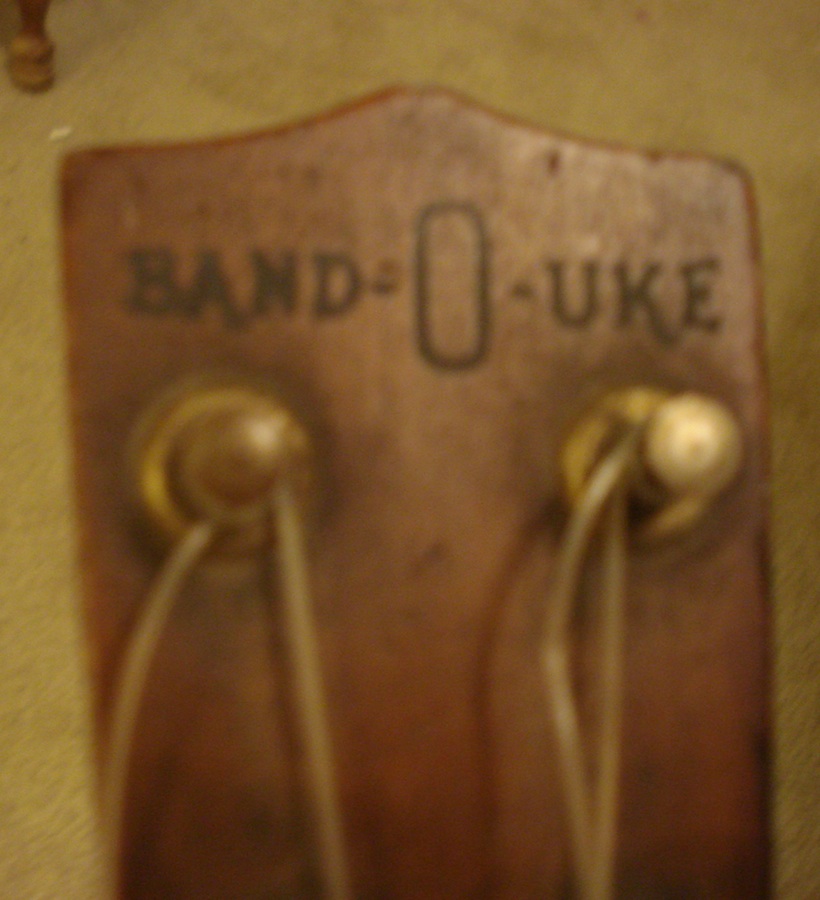
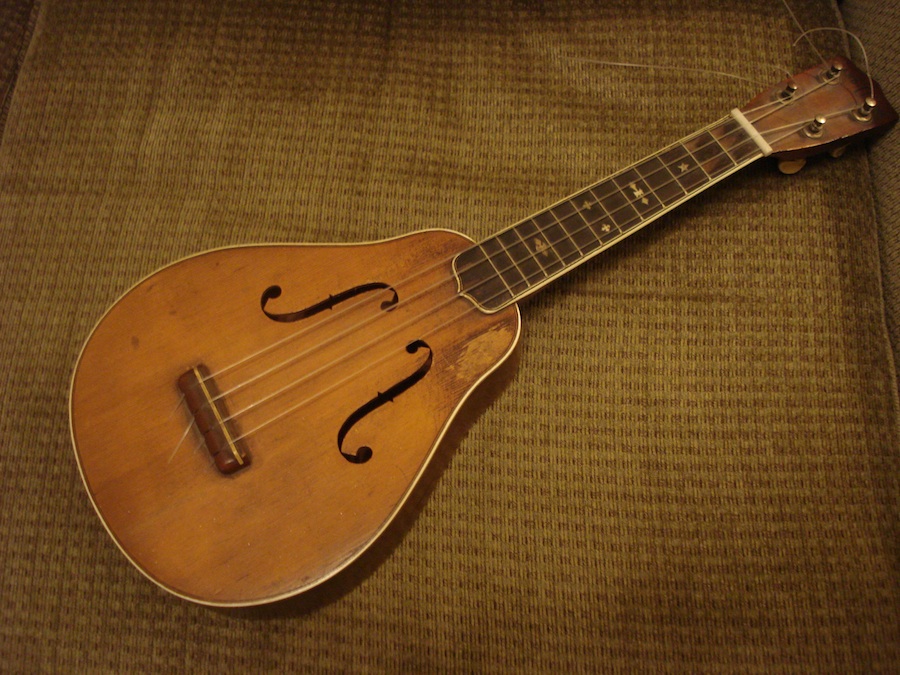
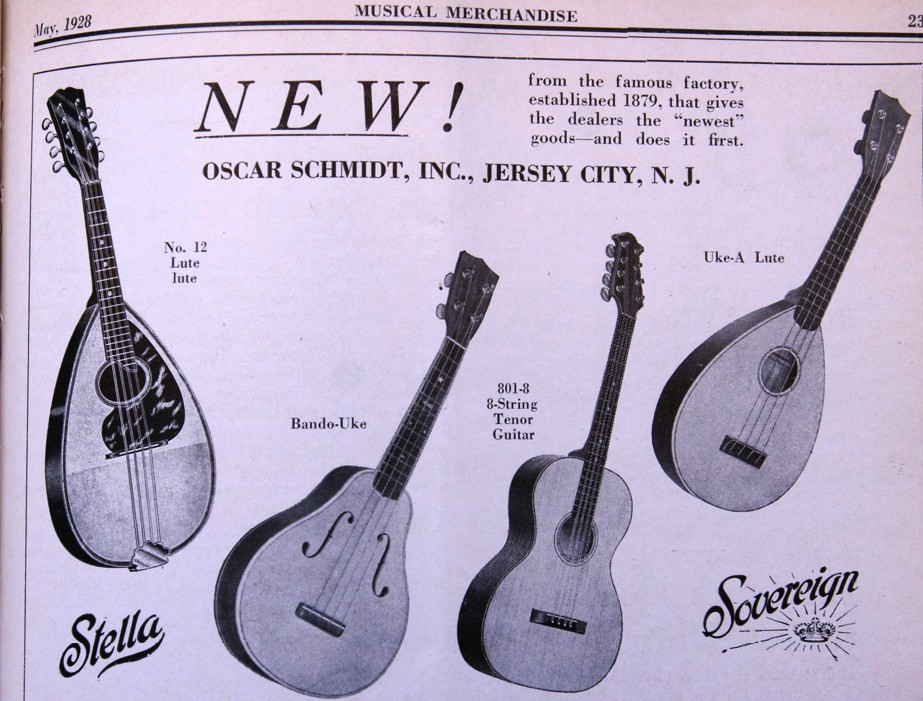
Answer: Thanks for the photos. That is a great looking ukulele. I have seen an ad for the Band-o-uke but I have never before seen an existing example. The Band-o-uke was a product of the Oscar Schmidt Company of Jersey City, NJ. I am posting an Ad from May of 1928 with a picture of the Band-o-uke. I am guessing that Schmidt did not make a whole lot of these, as I have never seen another. By May of 1928 the ukulele craze of the 1920s was dying out and I am guessing these were not made for long. Oscar Schmidt made mostly inexpensive beginners instruments — but your Band-o-uke looks to be a better quality instrument than the typical Schmidt product. It is a great little instrument you have.
Question: Hi, I was wondering if you could identify this ukulele for me, and give me an idea of its quality/age. The only thing it says is "Handmade Leonora" on the inside. A friend of mine said it looked like a 1920's Martin by the style. It plays wonderfully: it has a really rich sound. The strings in the photos are not original; I switched them out, but I still have the original strings and they are in fine shape. I inherited it from my great aunt. Thanks.
Answer: Your ukulele was made by The Rutan company of Kansas City, Mo. The company was named for the owner, John Rutan, who went into the ukulele business in 1926 (after being a partner running a retail music store). Their factory was eventually destroyed by a fire, I believe in the 1930s but I'm not exactly sure on that. Rutan made very nice quality instruments — very much in the style of Martin instruments. I would guess they patterned their instruments directly after Martins. While other manufacturers sometimes claimed to be as good as a Martin — Rutan ukuleles actually came quite close. Your ukulele is patterned after a Martin Style 2. It is all mahogany and appears to be in great condition (except for a possible crack on the side). I don't know anything about the "Leonora" name in the soundhole. It was likely a name used by a particular instrument retailer — but I do not know which one.
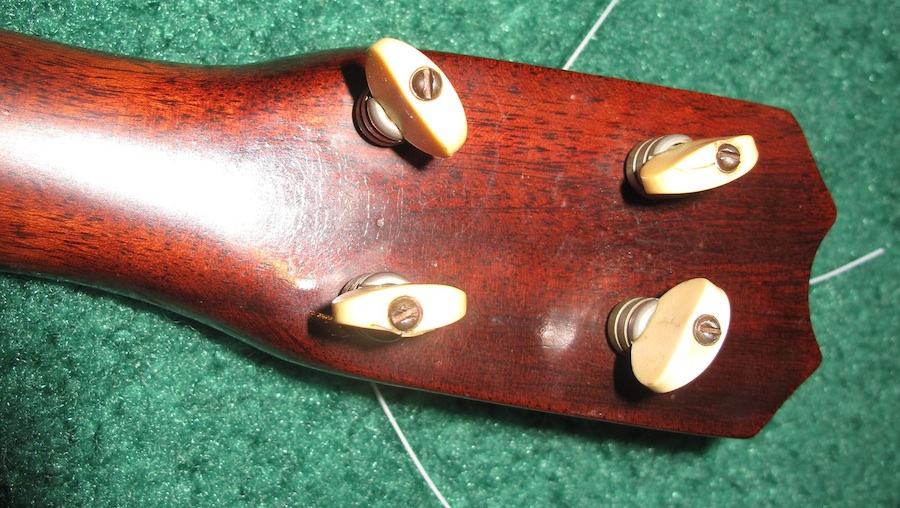
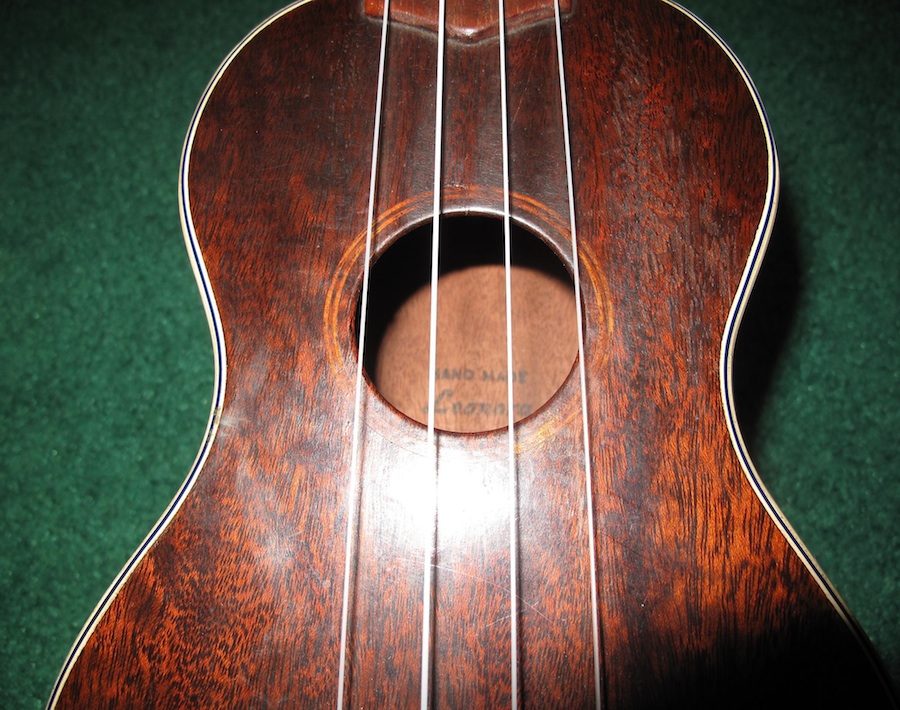
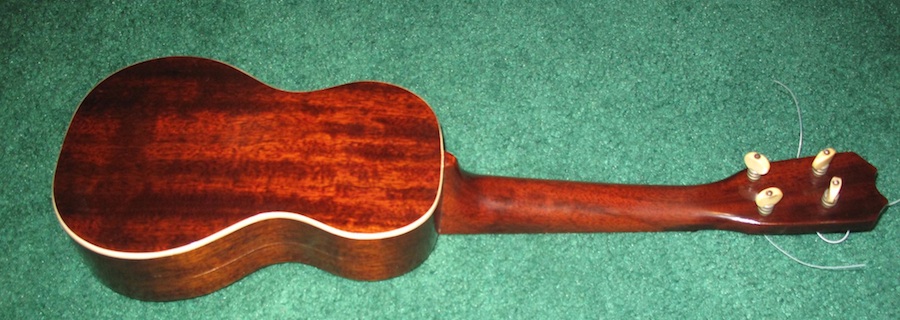
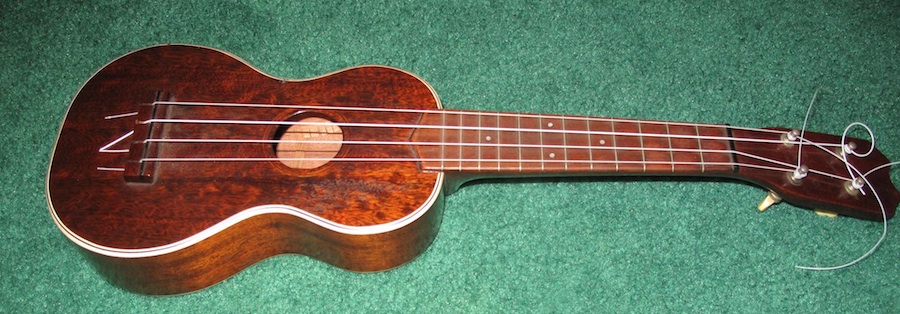
Question: Hello ʻUkulele Hall of Fame, I was wondering if you might be able to help me identify this ukulele. I bought this ukulele off of Ebay a few months ago. The tuners and nut are not original. It has 16 frets total. It has white binding with a black stripe wrapped around the neck, front, back, and sound hole. The binding is also used for the bridge. The ukulele is solid mahogany. There are mother of pearl fret markers on the 3rd, 5th, 7th, and 10th frets. It is slightly smaller in the body than a normal soprano ukulele. While small it has a very loud, bright tone and is a fantastic player! There are no maker marks anywhere on the ukulele. Thanks in advance for the help.
Answer: Your ukulele looks to me to be a model made by the JR Stewart Company. The beveled headstock, fretboard binding, and bridge shape all match with the style of ukuleles Stewart was making in Chicago in the late 1920s. It is also possible that it was made by Regal. A little background: JR Stewart worked for the Harmony Co. in the early 1920s before opening his own business making fretted instruments. The Stewart Company grew quickly in the second half of the 1920s. Their Le Domino line of instruments was quite popular and the company expanded rapidly. When Lyon & Healy stopped manufacturing their own fretted instruments in 1928, Stewart was chosen to manufacture the Lyon and Healy Washburn line of instruments. The Stewart company's rapid growth apparently led to its downfall. Less than six months after the stock market crash of 1929, JR Stewart declared bankruptcy. The Stewart trade names were sold to another Chicago Co., Tonk Brothers, who in turn sold them to Regal. Regal began making instruments nearly identical to the ones Stewart had been producing, including the Le Domino line. That is why it is difficult to say whether your ukulele is a Stewart or a Regal. Either way, it was likely made between 1925 and the early 1930s.
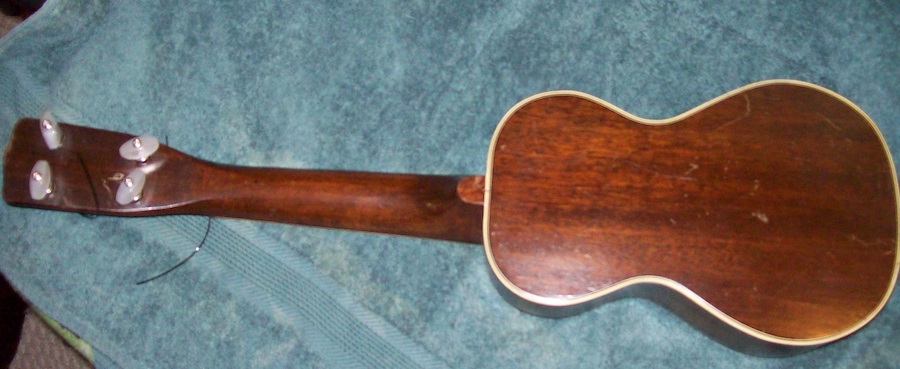
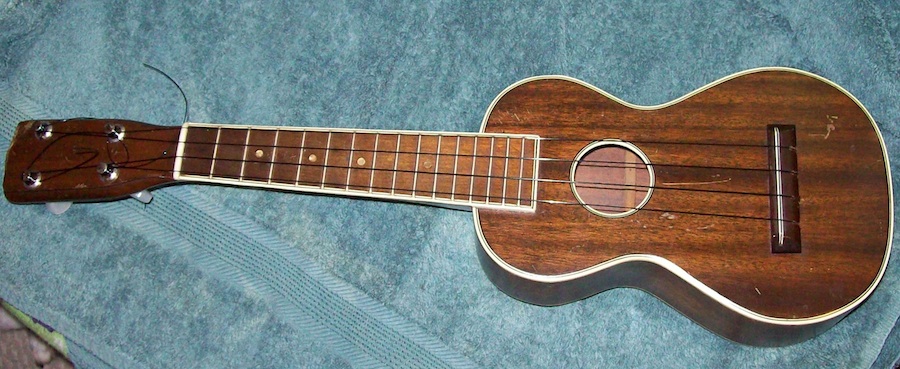
Question: I play a number of stringed instruments and thought it would be fun to also learn ukulele. I am having fun learning, but have no idea as to the identity of this ukulele I found in an antique store. The only identification is a small label inside reading "GENUINE HAWAIAN (sic) KOA WOOD." What is this ukulele?
Answer: Your ukulele was made by the Oscar Schmidt Company of Jersey City, NJ. Schmidt used the misspelled "Genuine Hawaian Koa Wood" label on some of their early ukuleles. I would estimate that your ukulele was made in the later teens or early 1920s. Most Oscar Schmidt ukuleles are rather inexpensive models. Yours is definitely one of their higher-end models, with the fancy headstock shape and nice koa wood. It also appears to be in great shape considering the age — congratulations on your nice find.
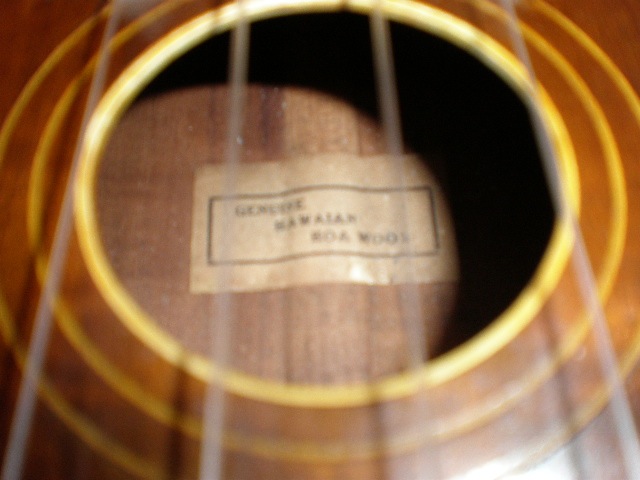
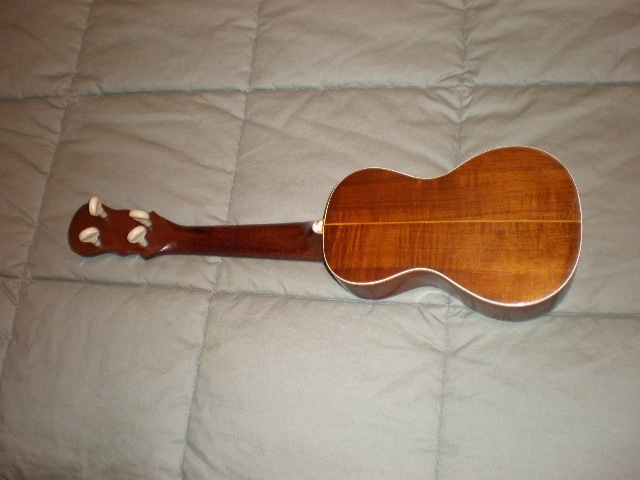
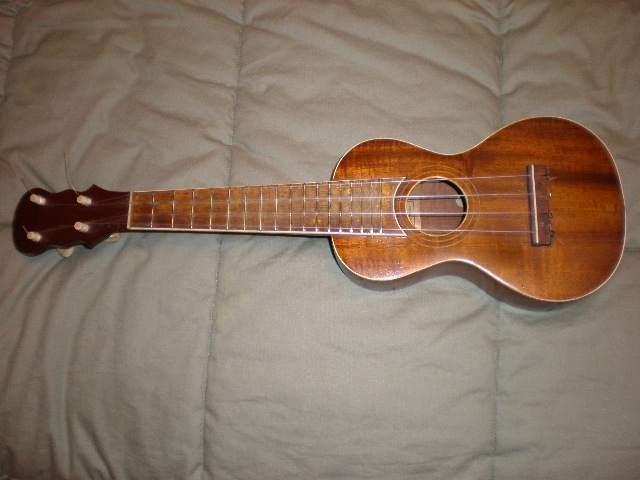
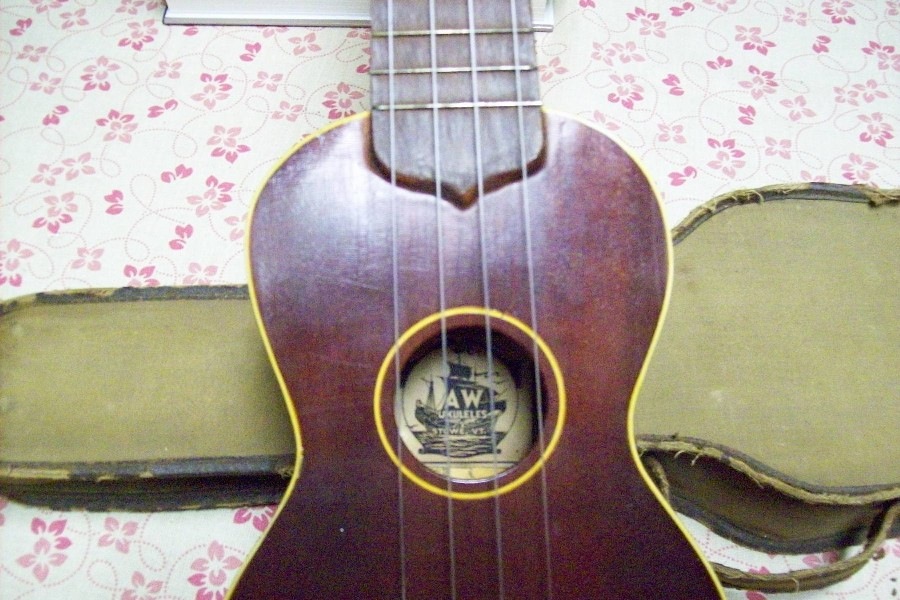
Question: We're trying to find some information about this ukulele. The label inside has a sailing ship and AW Ukuleles, Stowe, Vermont. There's also pencil writing inside that seems to say "Baker". Any info would be appreciated. Thanks.
Answer: Your ukulele was made by the Green Mountain Violin Corporation of Stowe, Vermont. They were a small company that originally made violins, but early in 1922 they branched out into the field of ukuleles and banjo-ukuleles. Their violins were sold under the "Artcraft" brand, while their ukuleles, banjo-ukuleles, and banjo-mandolins were marked "A.W." The "A.W." stood for "All Warranted". The company made instruments out of native Vermont woods. Unfortunately, it doesn't appear that they were around for too long. In June of 1922 a fire destroyed the factory and work stopped completely. Plans were made for re-organization, but I haven't found any evidence that the company ever produced instruments again. I have seen a few Stowe ukuleles before, and they seem to be patterned after the ukuleles that C.F. Martin & Co. was making at the time. They appear to be a good quality instrument, but I have never played one so I can't say much about the sound. I have never seen one with a label before, so thanks for sending the photos of yours. I assume that it was made in 1922, quite possibly the only year the A.W. ukuleles were made. As for the name Baker written in the uke, I'd guess that may have been the name of the original owner. Your ukulele is an unusual brand that doesn't turn up all that often. It appears to be in very nice condition.
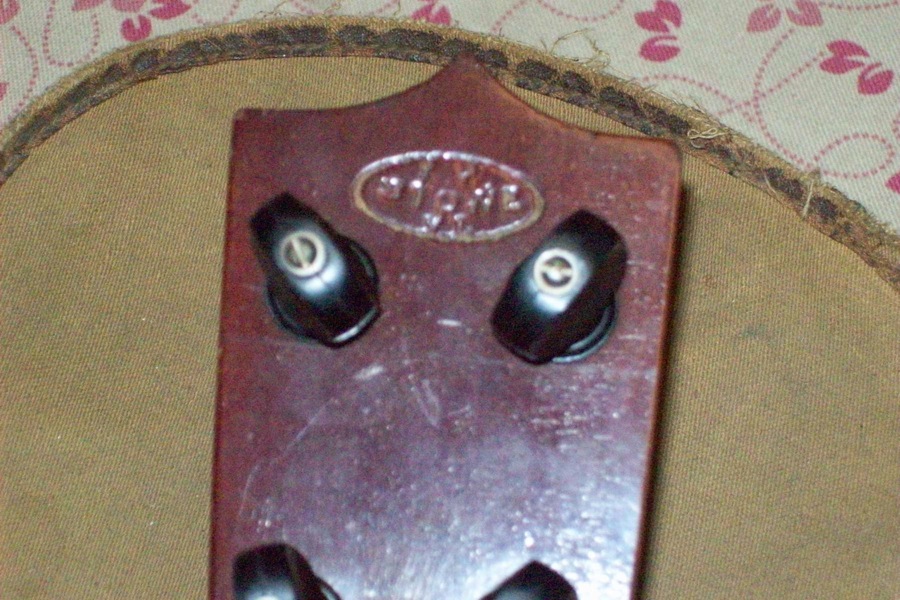
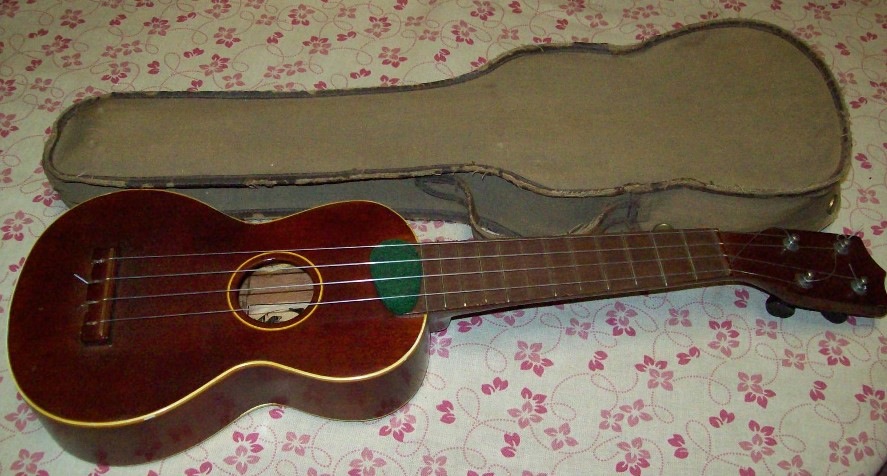
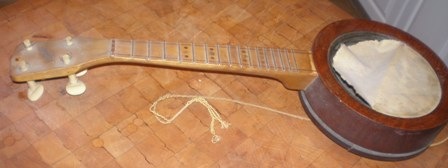
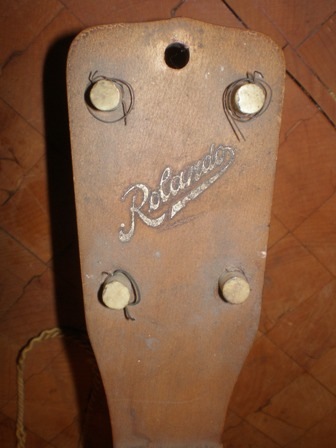
Question: Can you tell me anything about this Rolando?
Answer: You have a very early banjo ukulele. Rolando was a brand name used by the Southern California Music Company on banjo ukuleles and guitars (and possibly other instruments). Southern Cal even sold some Martin guitars with Rolando labels inside. Your banjo ukulele was probably made between 1916 and 1920. It was almost certainly made in California — nearly all the very early banjo ukuleles were. It was quite possibly made in the factory in the Los Angeles area that was the largest banjo ukulele manufacturer at the time. Your instrument is made from burled redwood; other (more common) styles of Rolando banjo ukuleles were made from alternating light and dark wood pieces. The hole in the headstock is original — every one of these I have seen has the same hole there.
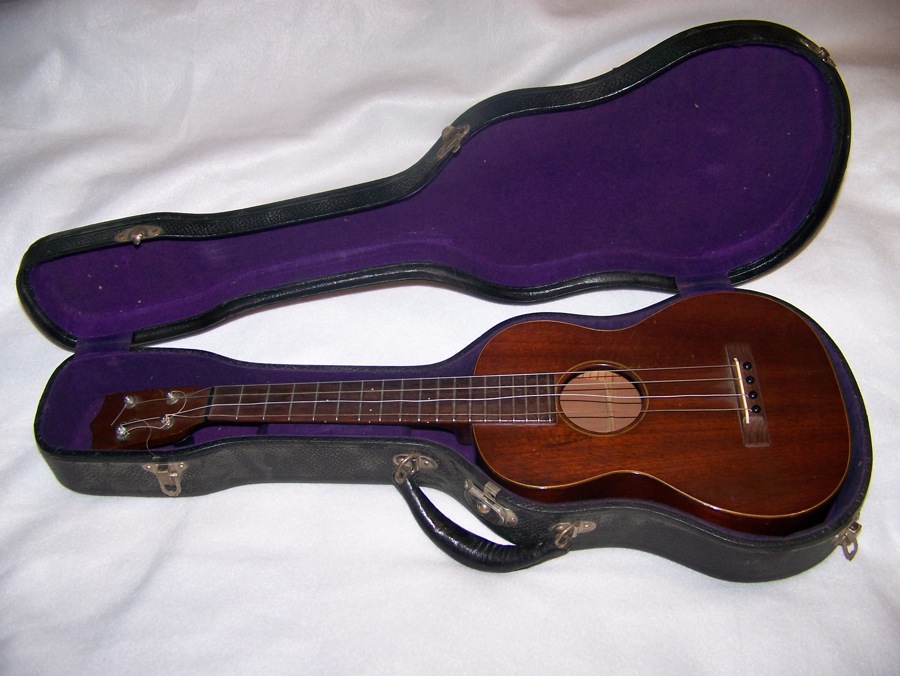
Question: I have recently acquired this Martin Ukulele. From the little research I have done it looks to be a Tenor model made around 1930 or earlier. It looks to be in good shape with no visible cracks and a few minor scratches. I was going to get some Martin Nylon strings and start playing it. Am I on the right track about the vintage and model? Any other thoughts?
Answer: As you surmised, your ukulele is an early Martin tenor made between 1928 and 1934 or thereabouts. It is a style 1T. It does look to be in very nice shape and it is great to find one with its original hardshell case. I agree you should get some nylon strings and get playing on it — it looks like a very nice instrument.
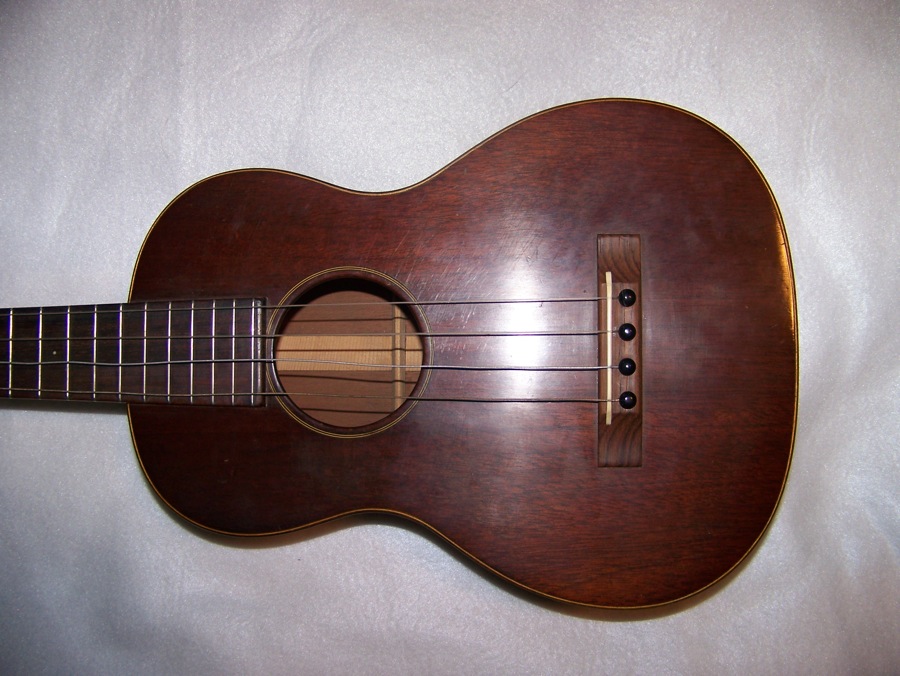
Question: Hello, I have this vintage soprano and I can't find any number, any brand or any sign to identify it. It plays well in BF#DA without buzz and with a low action. Could you help me to put a name on and an era of fabrication. Many thanks and good day.
Answer: Your ukulele was made by the Harmony Company of Chicago, Illinois. The bridge shape, soundhole decal, and pearloid fretboard are all clues that your ukulele is a product of the Harmony Company. I believe that your ukulele dates to the 1930s. Harmony was owned by Sears at the time, but produced instruments that were sold by many different retailers and jobbers. The fretboard and headstock on your ukulele are made from Pyralin — a plastic that resembles mother-of-pearl. These days, most vintage instrument dealers and collectors refer to it as "mother-of-toilet-seat" (MOTS).
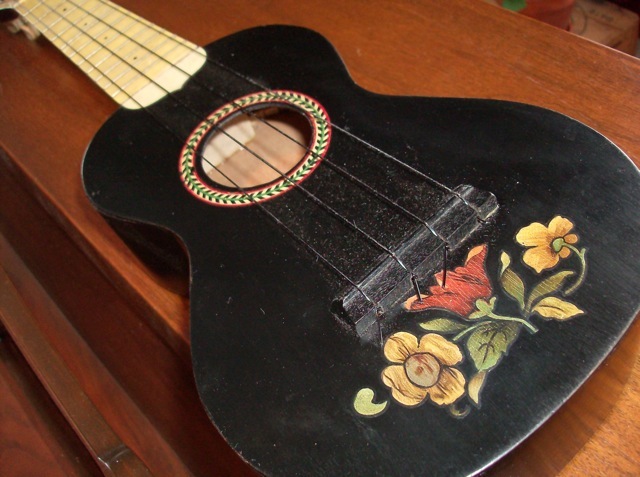
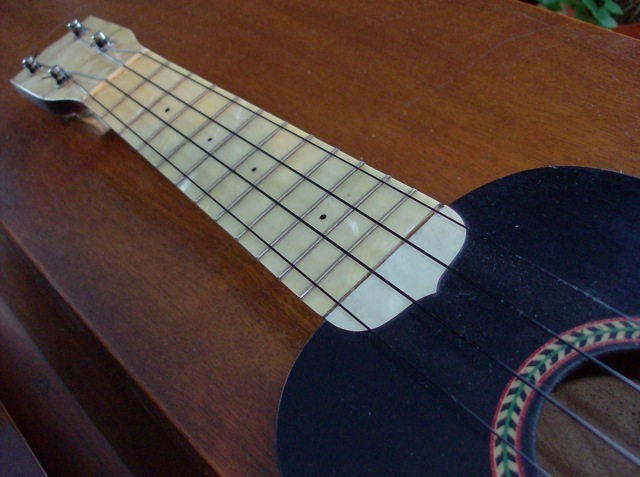
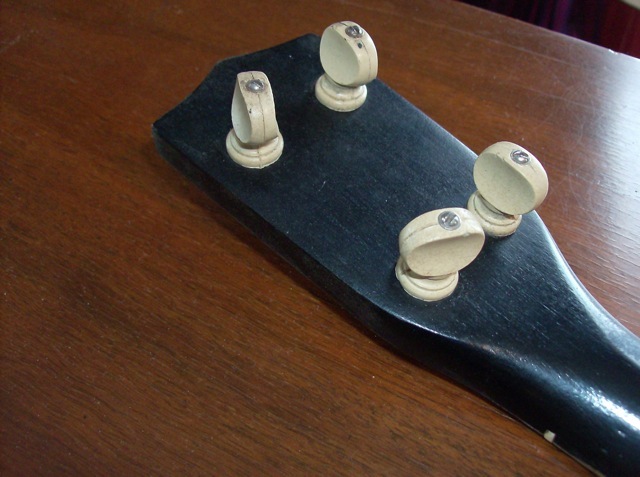
Question: I was wondering if you might be able to tell me some info about this instrument. I have never seen another with the five string and headstock on it as this one does. It is really a beautiful instrument in looks and sound and a joy to play. Thanks.
Answer: Your ukulele is a product of the Aloha Ukulele Manufacturing Company. The company was in business from 1917 to 1935 in Honolulu. The main ukulele builder there was Tai Chong Goo, who worked under the pseudonym Akai. The unusual headstock shape on your ukulele was used on many Aloha and Akai ukuleles, and I have never seen it used by another maker. While standard Aloha ukuleles are not particularly rare, yours is an extremely unusual model. I have never before seen a five-string model from the company. It is what is known as a five string taropatch, an instrument related to the Portuguese rajao. These were more popular in Hawaii in the late 1800s and very early 1900s. By the time yours was manufactured the eight-string taropatch had become common, and very few five-stringers were made. The eight string taropatch took on the tuning of the four string ukulele. The five string taropatch was typically tuned DGCEA, and that tuning is likely the source of the modern ukulele tuning. Taropatches were typically bigger than standard soprano ukuleles. Most sopranos are between 20 and 21 inches long overall, while a typical five string taropatch is about 26 inches overall.
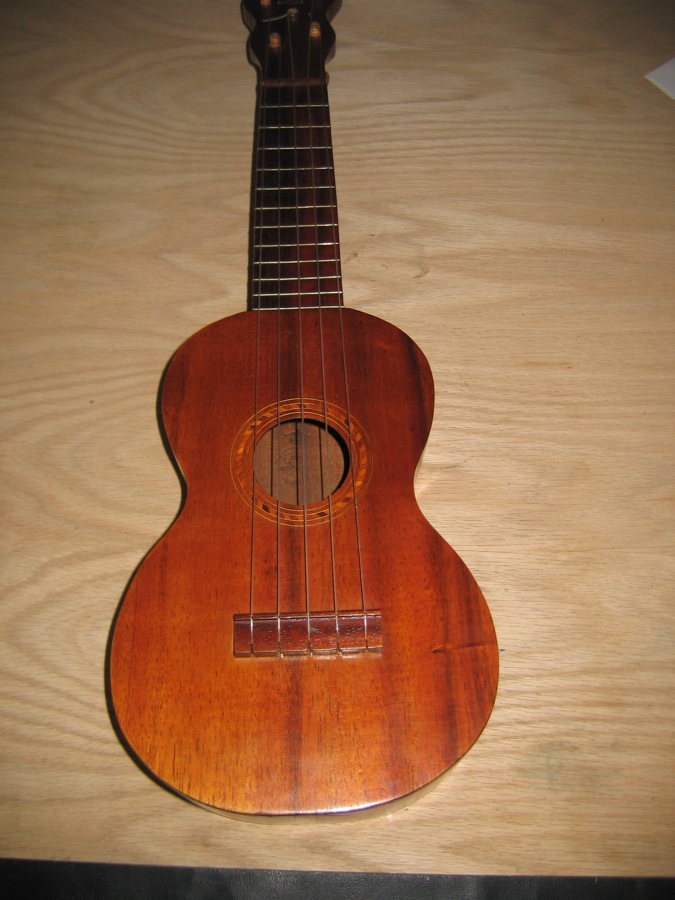
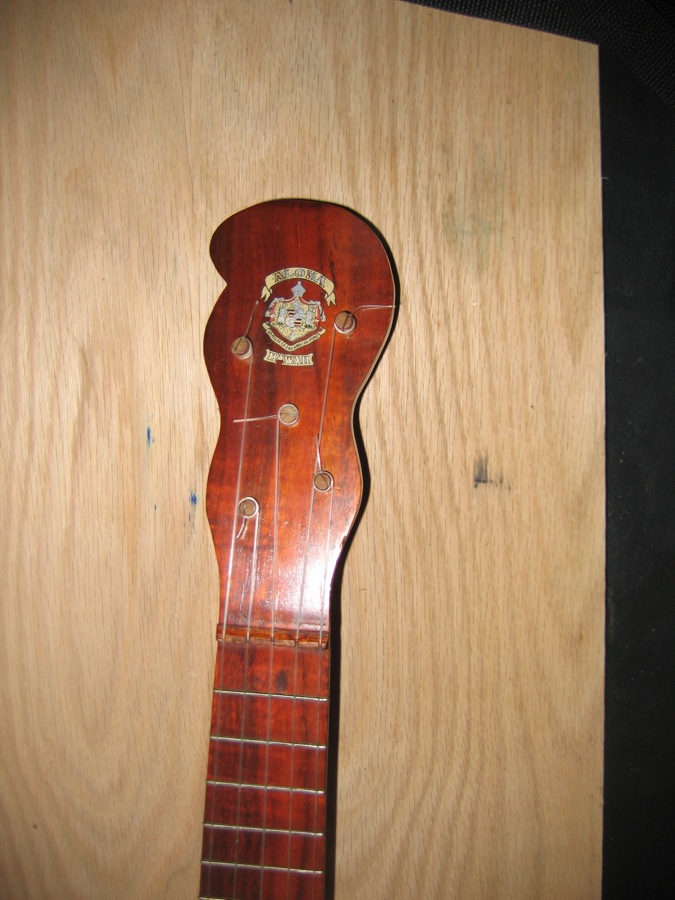
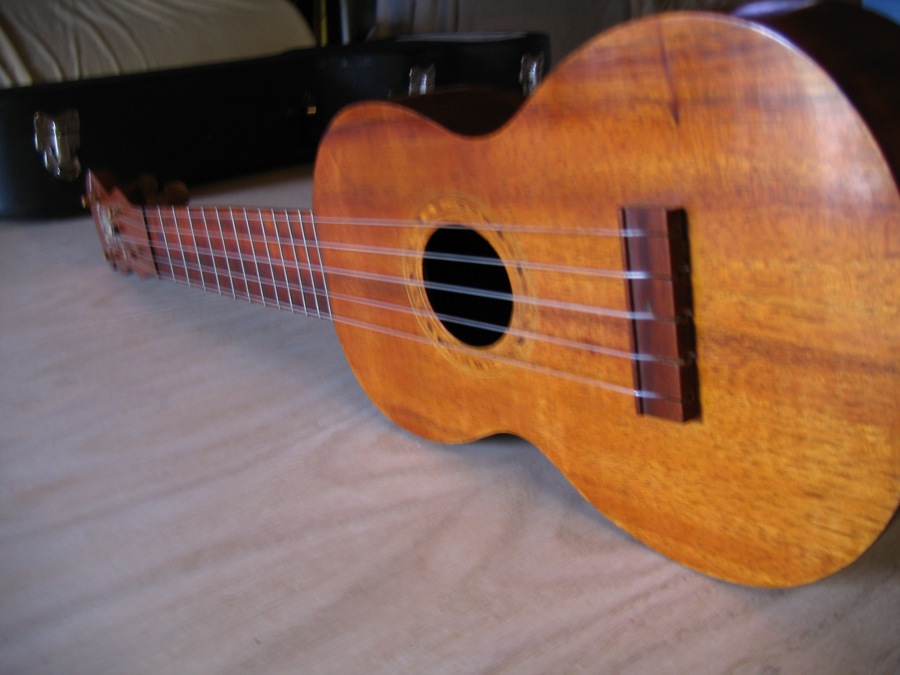
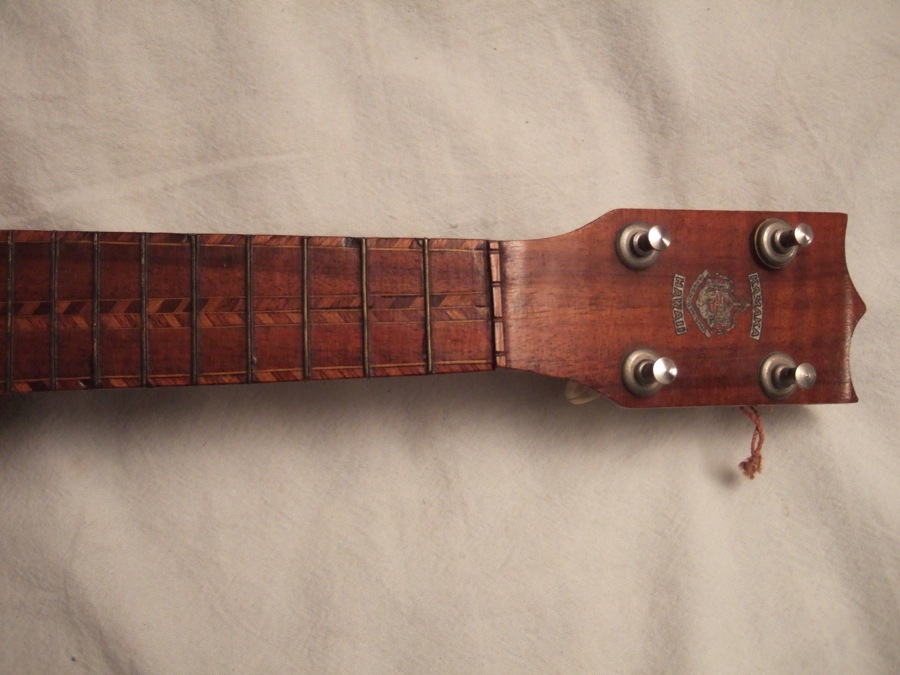
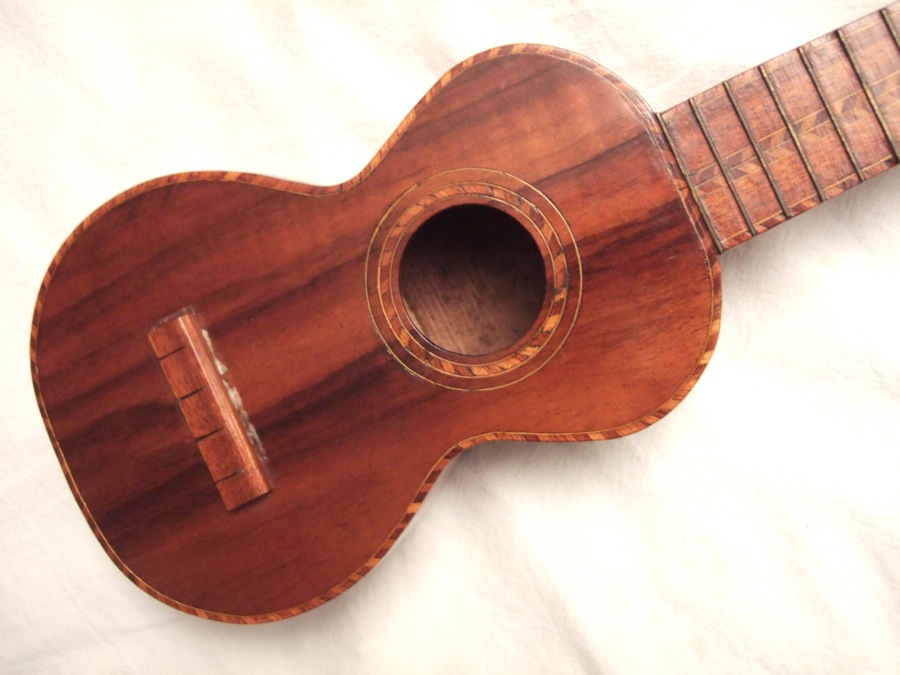
Question: Hello. Can you please give me some information about this old Kamaka? Thanks!
Answer: Your old Kamaka ukulele is great. It looks to be very early to me — probably made between the late teens and the mid 1920s. It is a very fancy model with the inlay on the sides and center of the neck. The decal is a rare Kamaka decal — I have only seen a couple of ukuleles with that particular decal. All in all it looks to be a very unusual and desirable old Kamaka — thanks for sharing the photos.
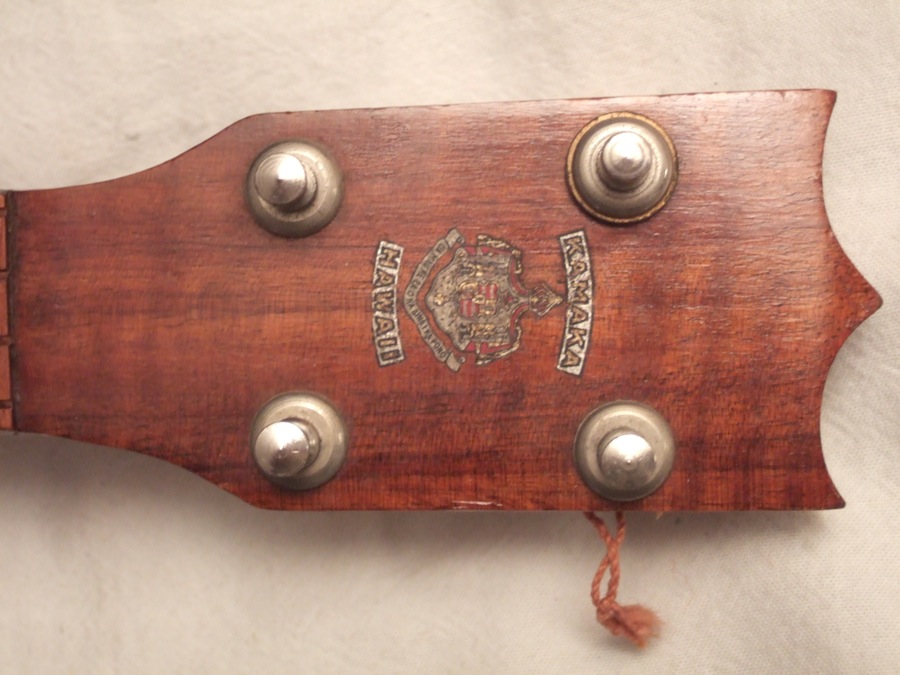
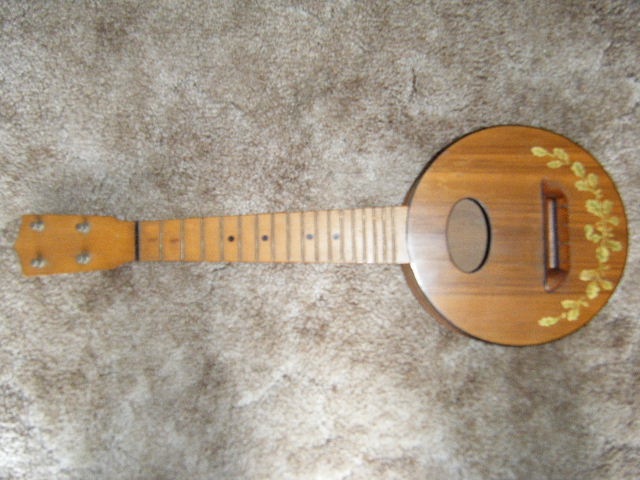
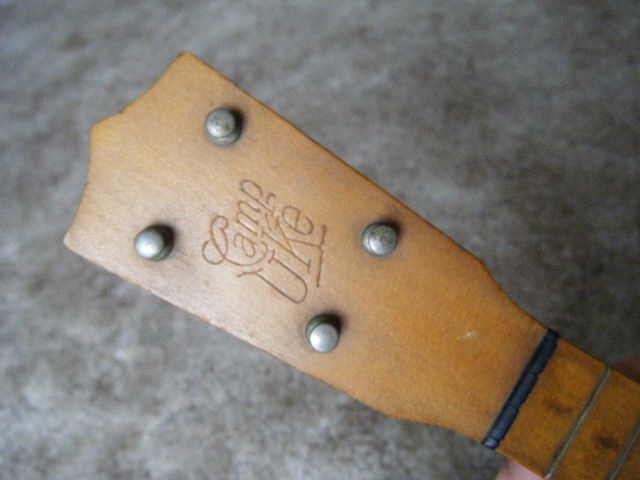
Question: This ukulele has been up on a shelf in my grandma's house for as long as I can remember. She told me that it almost got thrown out by her sister when her mother died, but she decided to hold on to it for decoration. She said that it never really got played. She recently gave this uke to me. I have done some research and although I was not able to find much, I think this may be a Lyon and Healy. I have seen photos of similar Camp Ukes, but none with the gold leaves on it. The bridge doesn't appear to be original, there are a few small cracks in the sound board, and there is a water mark on the side, but other than that it is in good condition. The two things that I find the most unique about it are the round body and the rounded back. I would like to find out more about this uke if it is possible. Thanks!
Answer: Your ukulele is definitely a Lyon and Healy Camp Uke. The gold leaf design makes this the high-end of the Camp Uke line. Lyon and Healy was one of the big distributors of musical instruments based in Chicago. The "Camp Uke" name was used on a line of ukuleles that included models that ranged from low to mid-priced. They are pretty durable little instruments and can sound pretty good. There were a number of different models made through the 1920s, all with round bodies. Some models had no soundhole at all, while more often they featured a circular or oval soundhole (like yours). Some have a flat wooden back, others have a turned wooden back. Fancier models like yours featured a gold-leaf decal below the bridge. The "Camp Uke" name was registered by Lyon and Healy in 1923, but they claimed first use in 1921. Lyon and Healy used unusual woods on some of their ukuleles. The Camp Ukes were made from Nyssa wood. The 1925 Lyon and Healy catalog features three models of Camp Uke all "made of two-ply, laminated Nyssa wood". The catalog states that the Camp Ukes are "exclusive Lyon and Healy products, made in the famous Washburn factory". The three models sold for $6.00, $7.50 and $10.00. Yours is the $10.00 model. In the early 1920s, your Camp Uke sold for the same price as a Martin Style 0, $10.
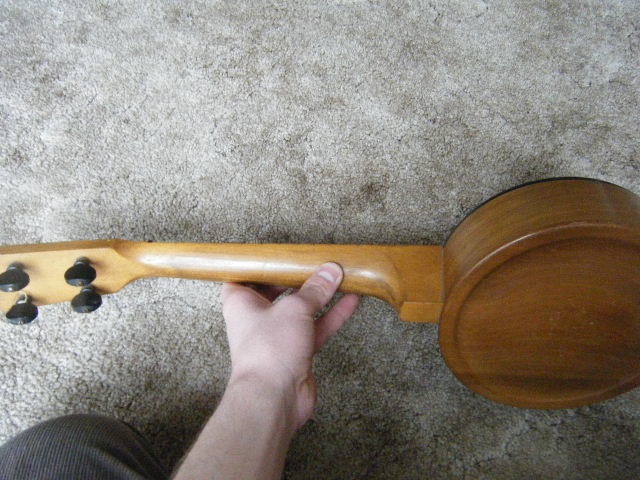
Question: Dear ʻUkulele Hall of Fame, My wife has asked me to get some information about this Kaai ukulele. It looks old to me — the label inside has faint pencil writing: appears to have number 1727C, 727C, 172 C (hard to read). The case seems to be made for it and fits perfectly. Even though somewhat roughly crafted, the tone is amazing. I do not know how to tune one of these (I own and play a Fender Telecaster and Fender Super Reverb amp myself), and the strings don't look right to me. Please tell me what you can, much thanks.
Answer: That is a very interesting ukulele you have. It looks to be made of koa wood and some very nice koa it is. Ernest Kaai sold ukuleles made in Hawaii as well as some that were mainland-made. It is hard for me to say for sure which of those you have. The heel of the neck isn't done in the typical Hawaiian ukulele fashion and the bridge is not typical of those found on Hawaiian-made ukuleles. Still, it is difficult to say who actually made it. According to John King's book "Hawaiian Ukulele and Guitar Makers 1884–1930" Kaai only used the 69 Young building address for one year — 1912. If your ukulele was actually made in 1912, then it was most likely made in Hawaii — I don't think there were any ukulele makers established on the mainland at that time. It was a high-end model when it was sold — lots of inlay and the fancy headstock shape. It is a very nice looking instrument. The standard tuning is GCEA with the C being the lowest note — so the strings don't go from thickest to thinnest in order.
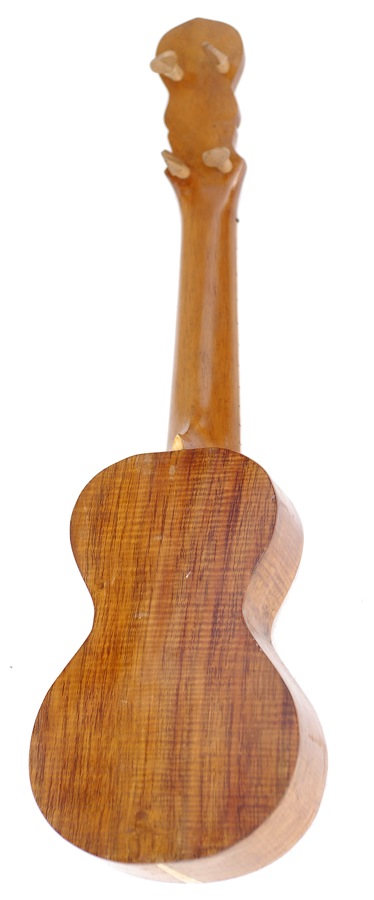
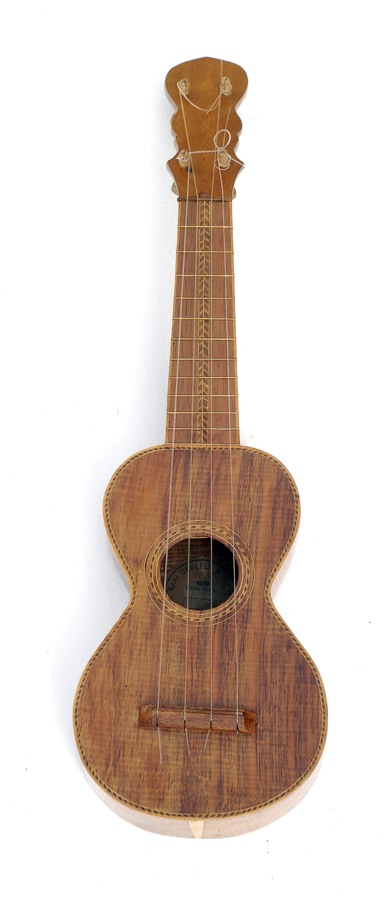
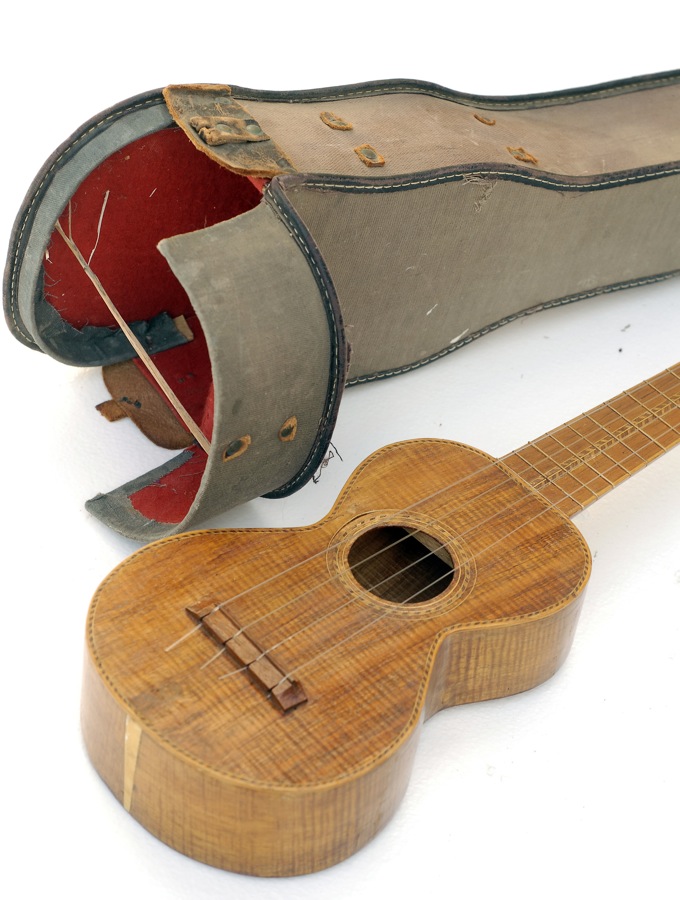
Question: Hello, I was wondering if you could tell me the approximate age of this Ukulele. Thank you very much.
Answer: That is a Martin Style 2 soprano ukulele. It is made of mahogany. Assuming the tuning pegs are original, it was most likely made between 1950 and 1962. If it is marked "Made in USA" inside the soundhole under the Martin stamp then it is from 1962 or later. The Style 2 was the middle instrument in the Martin soprano ukulele line.
Question: I bought this uke at a local auction. It is not marked by a maker. It does have an added wood plaque on the headstock that says, "Manufactured expressly for S. Ernest Philpitt Washington, DC, Miami, Tampa, Jacksonville Fla". The rope binding and skunk stripe are of very well done inlay. I think it is Hawaiian made with koa wood but I would like to know what your think. Any information you might have would be very nice. Thank you for your help.
Answer: Your ukulele was made by the Oscar Schmidt Company of Jersey City, NJ. It is made from Hawaiian koa wood. Many mainland manufacturers made ukuleles in the Hawaiian style, primarily in the teens and 1920s. Some of the characteristics that mark it as an Oscar Schmidt include the style of binding inlay, particularly the stripe up the center of the back, as well as the headstock shape. These ukuleles often had a paper label inside with a seated hula girl and the words "Hawaiian Ukulele" in big letters at the top and "Manufactured by the Oscar Schmidt Co., Jersey City, NJ" in small letters at the bottom.
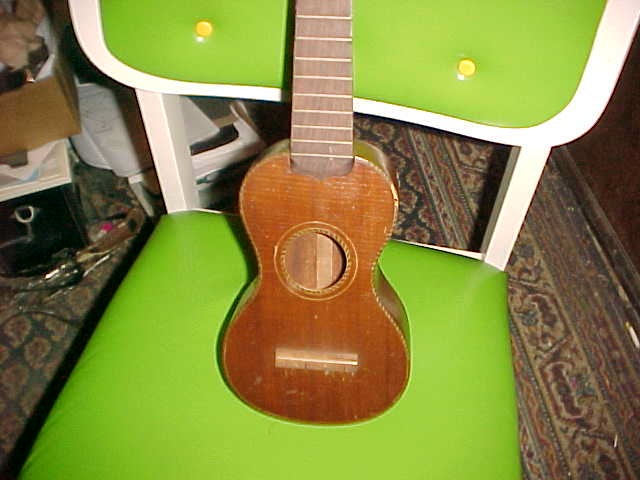
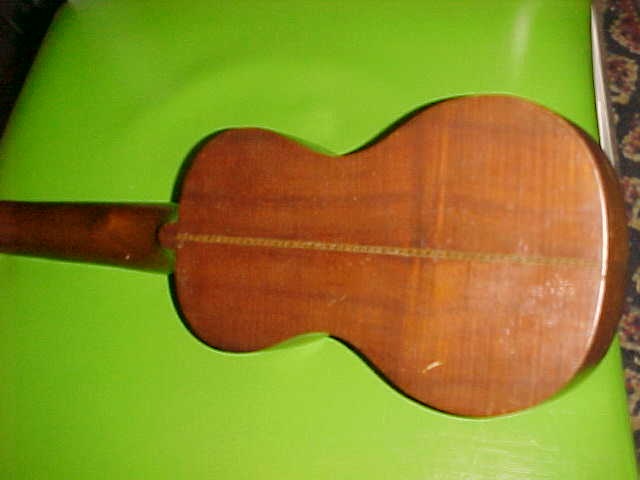
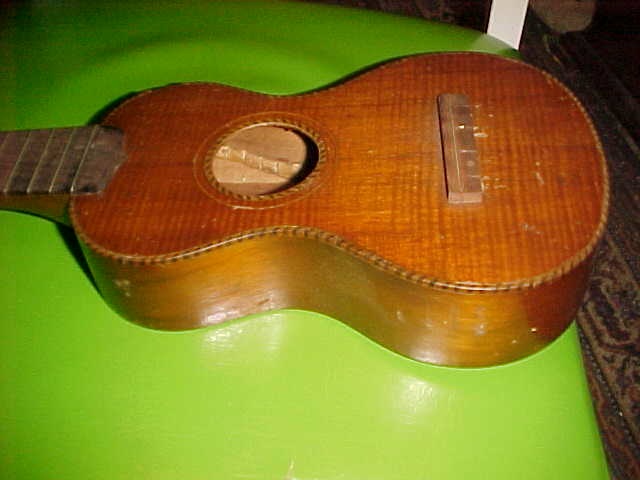
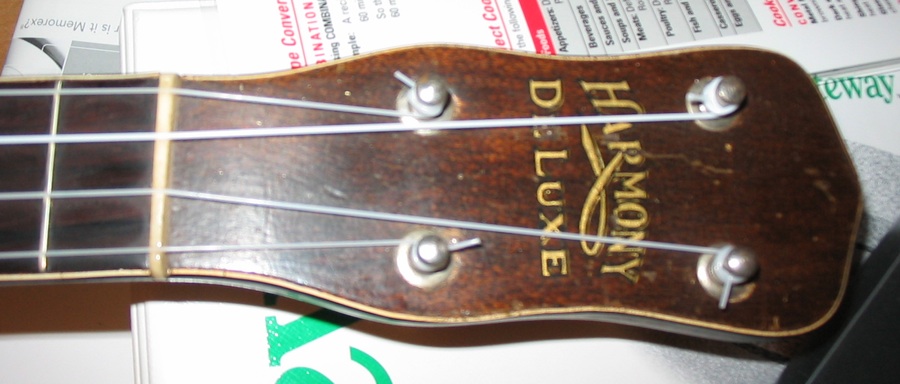
Question: Hi. I have a beautiful Harmony DeLuxe soprano ukulele made out of solid mahogany. It is obviously quite old, well made, and, judging by the scarcity of available information about it, pretty rare. I am having a very hard time finding out anything about it at all: its age, history, etc. Can you help me?
Answer: That is a very nice ukulele you have. I have seen other Harmony ukuleles with some of the same characteristics, but I haven't seen another exactly like yours.
Your ukulele was made by The Harmony Company of Chicago Illinois. Harmony was owned by Sears, and manufactured many instruments for Sears under the Supertone (and later, Silvertone) brand names. The headstock shape on your ukulele is the shape they used on many of the Supertone instruments that were sold in the 1920s and possibly into the 1930s. For many years Harmony did not put its own name on the instruments they built. This changed in the late 1920s, when they began producing some better instruments with the Harmony name on them.
I would guess your ukulele was made in the late 1920s. It was probably one of their top-of-the-line instruments. It looks to be made of some very nice quality mahogany. The bridge on it is very unusual — I wonder if it could possibly be a replacement. I don't see any evidence of re-gluing, but I have never seen a tie bridge on a Harmony ukulele.
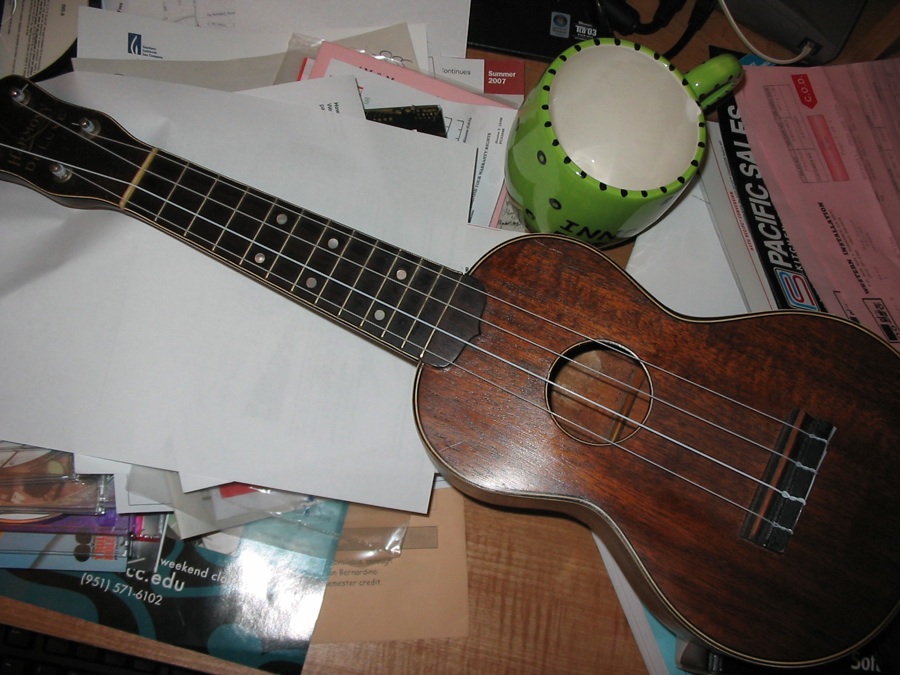
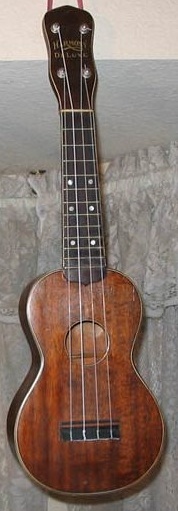
Question: Hello, I recently acquired this ukulele. It doesn't have any names, numbers or writing on it. Could please give any information? Was it made in Hawaii? Also, your take on types of woods used, especially the top? Thanks.
Answer: I'm quite sure that your ukulele was made by the Harmony company of Chicago, Illinois. It may well have been sold under the Supertone brand name by Sears Roebuck & Co. I would estimate that it was made in the 1920s. Harmony was owned by Sears at the time. Harmony's early ukuleles were made to look similar to Hawaiian ukuleles, and yours is a nice example of one of these. From the pictures I would say that your top is koa wood — the traditional Hawaiian ukulele wood.
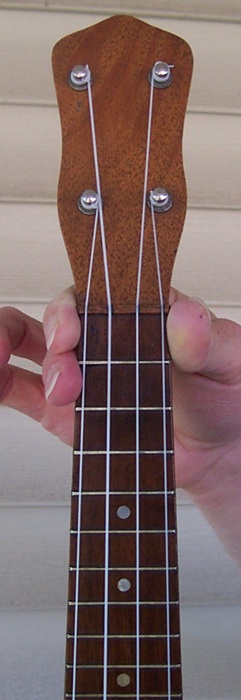
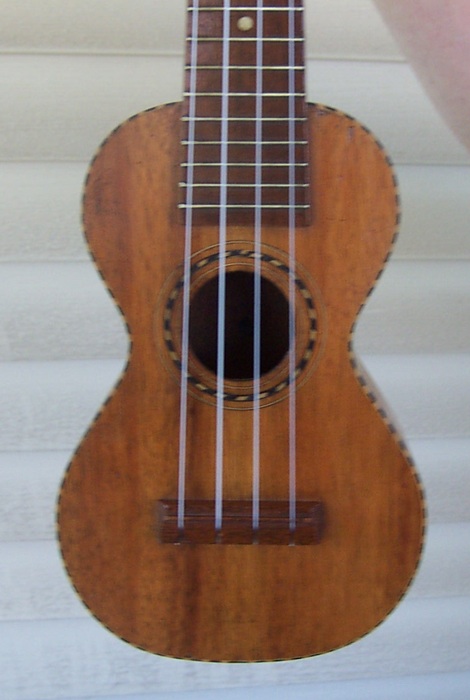
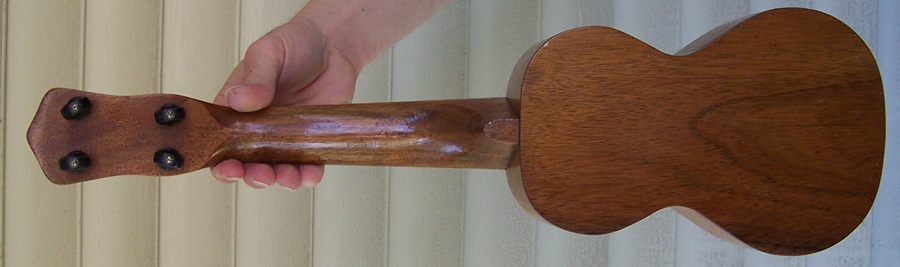
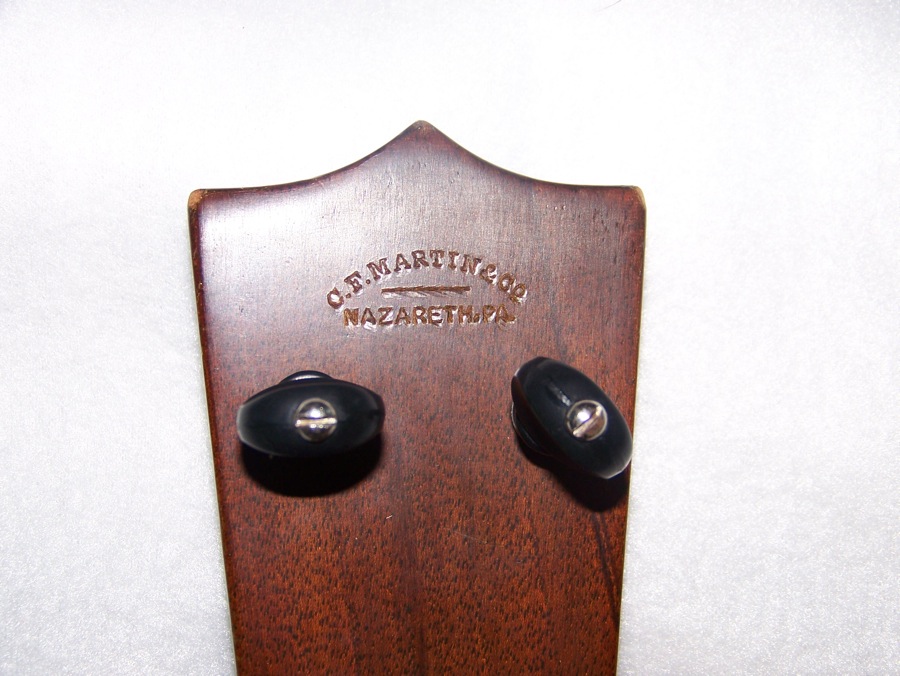
Question: Hey there! I acquired this ukulele a little over two years ago. It was left to me by my grandfather's uncle (a little shy of 101 years old) who was an antique collector. Unfortunately, this is all I know about its history, save for the obvious. It is in quite good condition, although it sports a few scratches on the neck and body. I am anxious to see what you think!
Answer: You have a very nice looking Style 2 ukulele manufactured by the CF Martin Co of Nazareth, Pennsylvania. It is made of mahogany. Based on the particular style of tuning pegs (manufactured by Kluson), I would estimate that it was made in the late 1940s or early 1950s. Martin ukuleles are considered by many to be the best ukuleles made, so they are desirable to players and collectors alike. It looks to be in very nice condition. At this time the Style 2 ukulele was one model from the top of the Martin ukulele line, above the Style 0 and Style 1, but below the "professional" model, the Style 3. They had already stopped producing their fanciest model, the Style 5K.
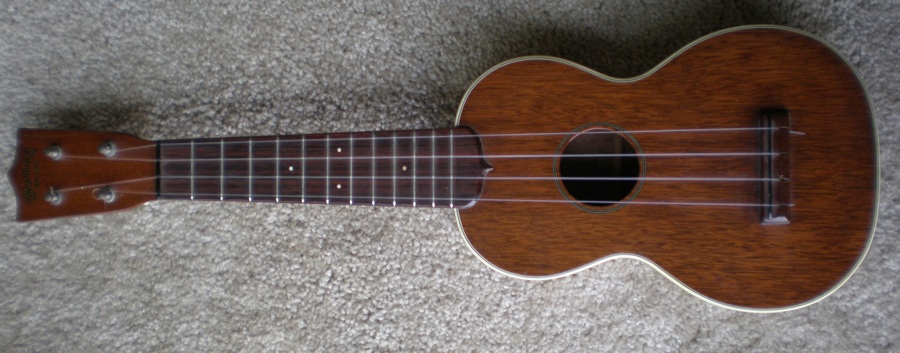
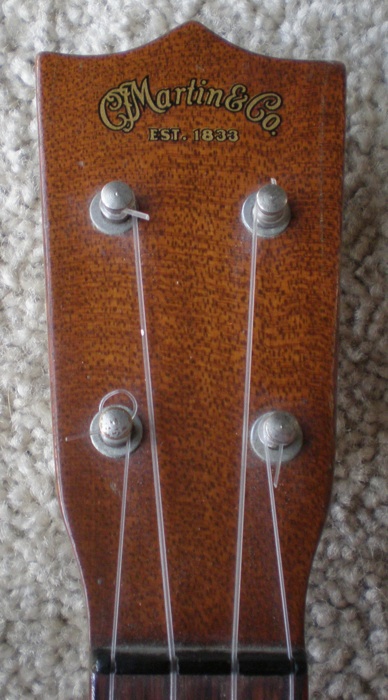
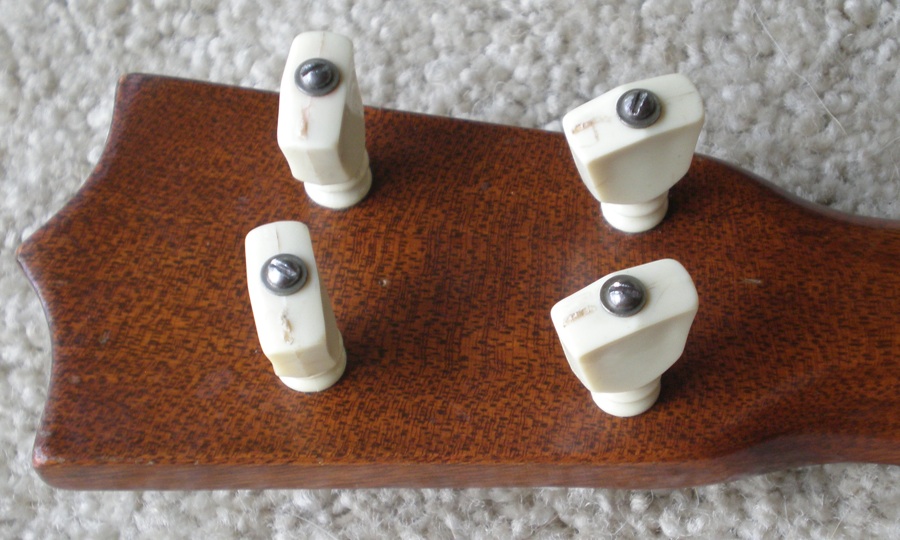
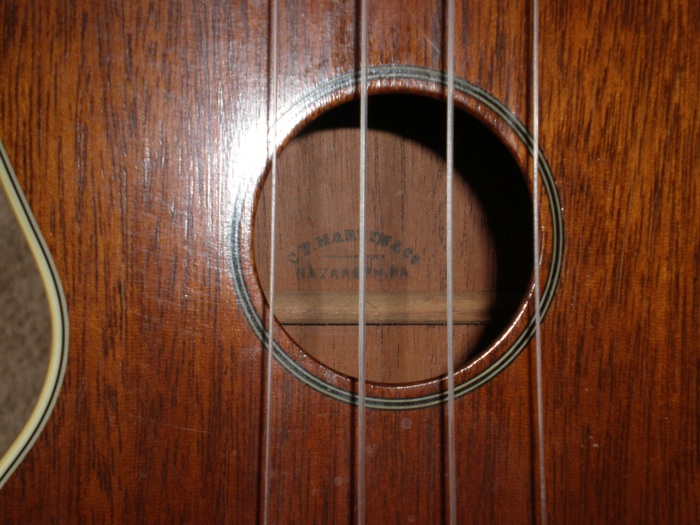
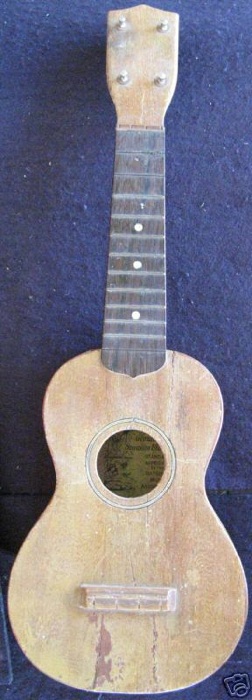
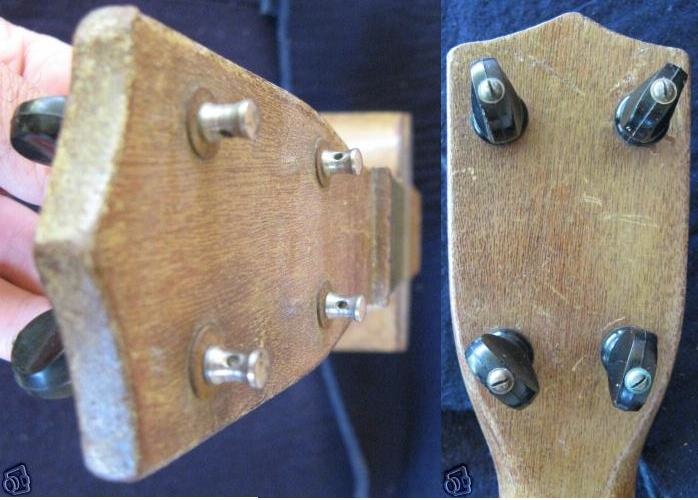
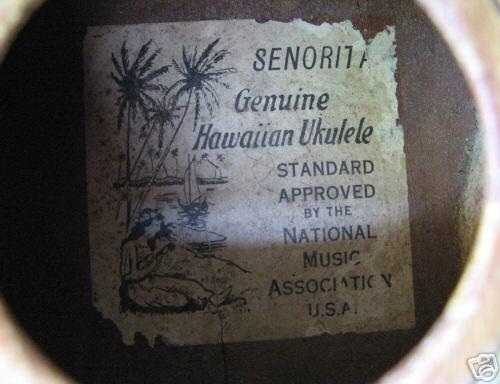
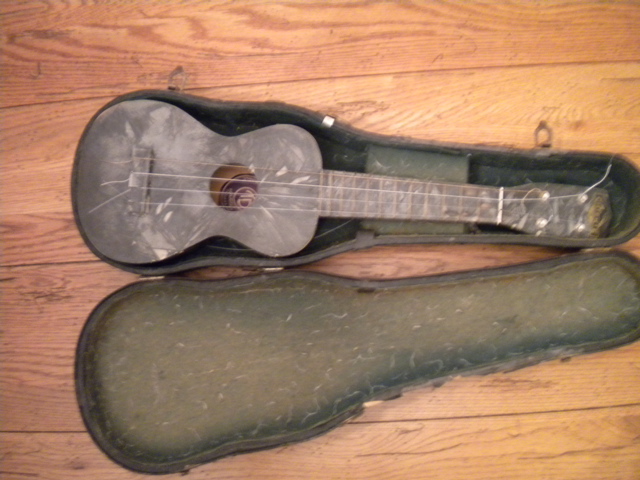
Question: Hi, great site. I recently bought this uke as a bit of a project repair job. I know it's not one of the "classic" brands, but I'm curious and enthusiastically refurbishing it in my spare time. It says "Senorita genuine Hawaiian Ukulele" on the label, looks like it might be mahogany. Has bakelite tuner knobs, the seller tells me it's from the 40's. A colleague tells me it looks like it might be a Martin copy from that period. Do you have any ideas on its history or seen anything like it? Thanks for your time!
Answer: That is an interesting label in your ukulele — I'm not sure that I have seen that one before. Senorita was a brand used on ukulele strings and also on banjos (by a few different companies), but I have never seen a Senorita ukulele before.
Your ukulele looks to have been made by the Harmony Company of Chicago, Illinois. I would estimate that your ukulele was made in the late 1920s or in the 1930s. The shape of the bridge on your ukulele is typical of Harmony ukuleles made in this time period. When I first saw the label photo I thought it was a more recent ukulele, but the "Standard Approved" mention makes me think it is older. The "Standard Approved" designation shows up on many Harmony-made ukuleles. This standard was created in 1927, and many Harmony ukuleles made for the next ten or so years had a special "Standard Approved" label inside the body. However, I have never seen a label like yours that mentions the "Standard" on the larger ukulele label. Thanks for sending the photos.