The Journal of the ʻUkulele Hall of Fame
Ukulele Ladies
Exploring Some Early Ukulele Method Books and the Women Who Authored Them
by Tom Walsh
There were a huge number of ukulele methods and songbooks published during the first nationwide surge in ukulele interest between 1915 and 1930. The vast majority of the ukulele books from this period were written by men. However, books by women were not unheard of. In this article, we'll take a closer look at a few of these method books, and the women behind them.
May Singhi Breen
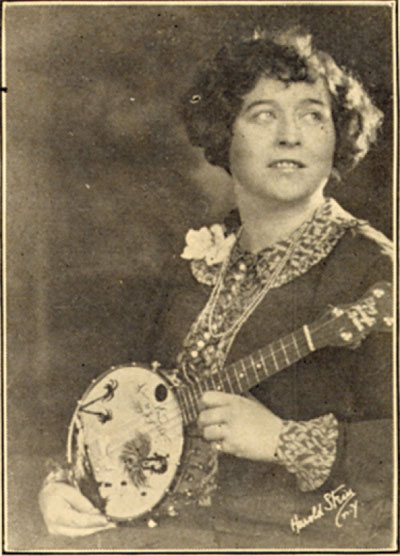
May Singhi Breen was one of the most prominent ukulele book authors, male or female. She was the original "Ukulele Lady" — taking up the nickname years before the release of the popular song of the same name. She is the only one of the women authors discussed in this article who produced more than one ukulele book. She wrote a number of early method books. The first, May Singhi Breen's Ukulele Songs and Method,1 was published by the William J. Smith Co. in 1924. This is an in-depth method and songbook with the first 26 of its 56 pages devoted to chords, strokes, and exercises. In 1925 she and her husband Peter DeRose co-authored the Peter Pan Ukulele Method,2 which they published through their own company Uke-Trades Publishing. This method is much more basic than her previous method, with simple chords and songs that beginners could play.
She is also credited as the editor on the 1925 Wendell Hall's Ukulele Method.3 Breen also did the ukulele arrangements for a great many other songbooks, including the Remick Collection of Popular Songs with Ukulele Accompaniment, No. 7.4 (The first 4 volumes of this series were arranged by Zarh Myron Bickford, the husband of Vahdah Olcott Bickford — another of the authors in this article.) Breen was an extremely prolific arranger for the ukulele and is credited with the idea of including ukulele chord diagrams on popular sheet music. Her contribution to ukulele instructionals also includes a 78 rpm record described in an ad as "A Six-Minute Course on How To Play The Ukulele" (Victor Record No. 19740). Her interest in the ukulele was life-long — she wrote a number of other ukulele books during the resurgence in interest in the ukulele in the early 1950s. May Singhi Breen is currently the only female inductee of the ʻUkulele Hall of Fame.
Vahdah Olcott-Bickford
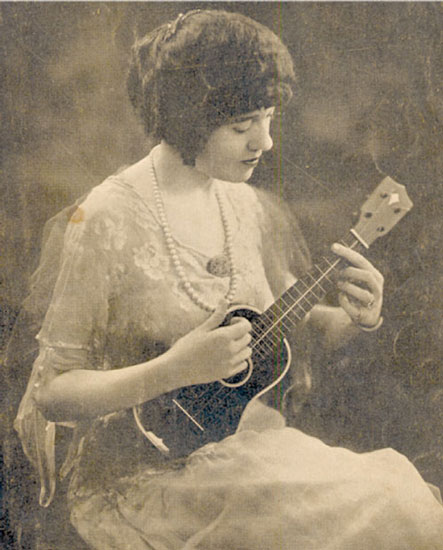
Vahdah Olcott-Bickford and her husband Zarh Myron Bickford co-authored The Bickford Method for the Ukulele,5 published in 1920 by the Oliver Ditson Company. Bickford is renowned in the classical guitar world as an author, teacher, and performer, and is considered "The pre-eminent American guitarist of the early 20th century."6 She amassed one of the most important collections of guitar music anywhere, now housed at California State University, Northridge in the International Guitar Research Archive. Zarh Myron Bickford was also an accomplished stringed instrument player, and did the arrangements for the first four volumes of the Remick Collection of Popular Songs with Ukulele Accompaniment7 between 1917 and 1924. Born Ethel Lucretia Olcott and Myron Bickford, the couple's interest in astrology led them to take the "astrological names" Vahdah and Zarh.8
In the foreword to her ukulele method, she pushes for the use of "legitimate music notation" and maintains that ukulele chord diagrams "are a great detriment to the musical advancement of the pupil." Although it is clear she takes music seriously, she seems to not take the ukulele too seriously — she mentions that "No attempt has been made to make more out of the ukulele than its capacity warrants." The Bickford Method for the Ukulele was apparently Vahdah's only work for the instrument; her interest in the ukulele was apparently not as long lasting as her dedication to classical guitar.
Myrtle Stumpf
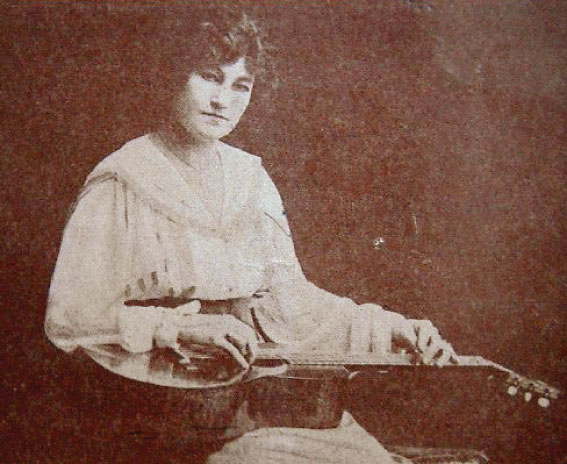
Myrtle Stumpf authored Stumpf's Ukulele-Method and Solo Book,9 published in 1917 by The Southern California Music Company. Stumpf was a well-regarded steel guitar player who was a student of Joseph Kekuku,10 the person many regard as the inventor of the steel style of guitar playing. She wrote what may be the first published method for steel guitar in 1915. Stumpf was highly involved in the early world of Hawaiian stringed instruments. In the late teens she wrote for Crescendo magazine in a column called the Hawaiian Round Table. She shared the authorship of the column with C. S. DeLano, another well known steel guitar and ukulele player and instructor. The column carried all sorts of information about the ukulele and the steel guitar.
Sadly, Stumpf died just as Hawaiian stringed instruments were entering their heyday. In the January, 1920 issue of Crescendo, C. S. DeLano mentioned her passing with these words: "Permit me here to pay respectful tribute to Myrtle Stumpf, whose untimely death in October was a severe shock to her many friends. She was a lady of fine personality and a player and writer of ability."11
Jennie Durkee
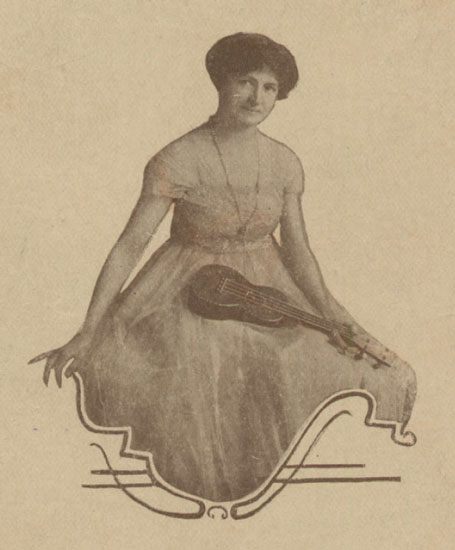
Jennie Durkee is not as well known as some of the other female authors of ukulele methods. Her method, The American Way of Playing Ukulele Solos,12 came out in 1917 and was revised and copyrighted again in 1919 and 1920. It is one of few ukulele methods developed particularly to describe a playing technique using a "thick felt plectrum." She describes how the felt pick can be used with a "very rapid down and up stroke" to produce "a most desirable tremolo or sostenuto affect" (sic). Her method book was apparently self-published originally, the cover reading "Published by Jennie M. Durkee, 2705 Kimball Ave., Chicago, Ill." Lyon and Healy later distributed her method — perhaps they picked it up to reward Durkee for the plug she gave them in the book. When discussing the various felt picks that were available she states, "The Lyon and Healy No. 5 pick is the best."
Although she has no other known published works for the ukulele, Durkee did make at least one radio appearance. On May 20th, 1922, the New York Times listed her in the column "Today's Radio Program." At 8:00 PM, Station KYW of Chicago aired both an "Ukulele Solo with Guitar accompaniment" and an "Ukulele Solo with Mandolin Accompaniment" by Jennie Durkee and Wayne Wadhams.13
Angeline Nunes
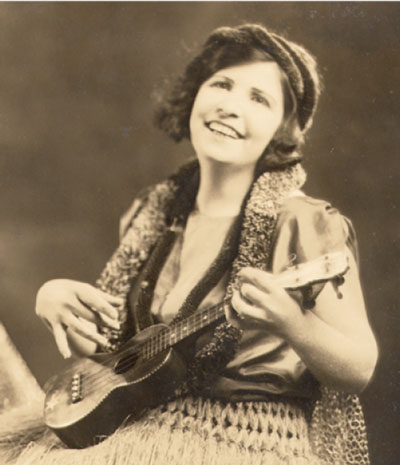
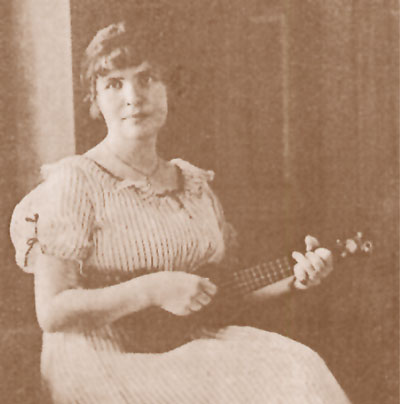
Angeline Nunes co-authored The Original Method and Self-Instructor on the Ukulele14 with A. A. Santos. Published in 1915, this was the first ukulele method written (actually co-written) by a woman. Angeline Nunes was the daughter-in-law of Hall of Fame Inductee Manuel Nunes, the ukulele maker. She was married to Julius Nunes, Manuel's son who was the Nunes ukulele shop supervisor for a period of time.
The method book, published by Santos-Nunes Studios in Honolulu, is one of very few ukulele methods actually published in Hawaiʻi. It is also unusual as it is the only ukulele method that uses the Madeiran machete tuning, DGBD. All others use the modern GCEA (or ADF♯B) tuning adapted from the tuning of the first four strings of the five-string Portuguese instrument known as the rajão.15 This method was Nunes' only published work associated with the instrument. Her career was as a school teacher — she taught a variety of subjects but specialized in music.
Lucy Goodwin
Goodwin's Class or Group
Ukulele Course
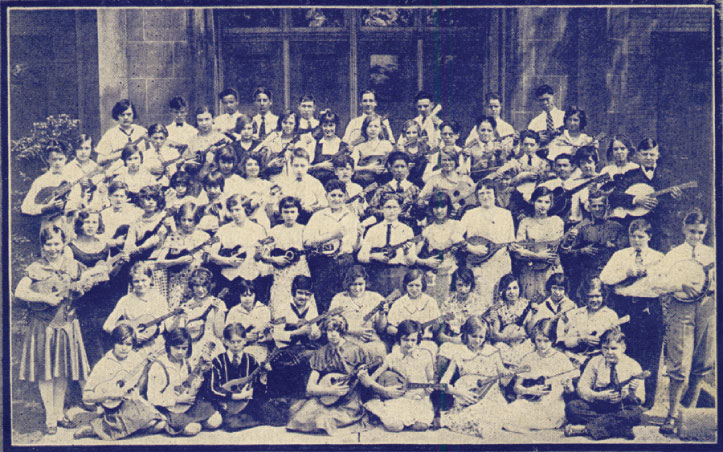
Lucy Goodwin, of the Chicago Public Schools, authored Goodwin's Class or Group Ukulele Course16 in the early 1930s. It is a guide for those intending to instruct large groups of ukulele players and describes itself as "Invaluable to Music Teachers and Supervisors, Recreational and Playground Directors, Camp Club and Group Leaders." Published by the M.M. Cole Publishing Co. of Chicago, this method also clearly is tied into the Harmony Musical Instruments Company (which was owned by another big Chicago company — Sears, Roebuck and Co.). The booklet has two full pages of pictures of "Typical Instruments Used for Plectrum Orchestras" and every instrument shown is clearly a Harmony Co. instrument. There is also a full page ad on the back for the Harmony Classmate ukulele, available in standard size for $3.00 and Tenor size for $4.00.
The tie-in with the method book is perfect, as it says in the ad "The 'Classmate' Ukulele is an especially designed standard approved instrument for group and class work." It goes on to describe how "your group will always make a lasting impression before any audience if all members are uniformly equipped with 'classmate' ukuleles." This is the only known published work by Goodwin and little is known about her except the information that appears in the book. In the foreword, she mentions that she has been teaching ukulele to children for five years, and that "the ukulele work of my pupils has become widely known and as widely appreciated; especially since the public have on numerous occasions heard the groups over the radio."
Notes
- May Singhi Breen, May Singhi Breen's Ukulele Songs and Method (New York: William J. Smith Music Co., 1924).
- May Singhi Breen and Peter DeRose, Peter Pan Uke Method (New York: Uke-Trades Pub. Co., 1925).
- May Singhi Breen, ed., Wendell Hall's Ukulele Method (Chicago: Forster Music, 1925).
- May Singhi Breen, arr., The Remick Collection of Popular Songs with Ukulele Accompaniment, No. 7 (New York: Jerome H. Remick & Co., 1926).
- Vahdah Olcott-Bickford and Zarh Myron Bickford, The Bickford Method for the Ukulele (Boston: Oliver Ditson Co., 1920).
- John King, Famous Solos & Duets for the Ukulele (Pacific, Mo.: Mel Bay Publications, 2004).
- Zarh Myron Bickford, arr., The Remick Collection of Popular Songs with Ukulele Accompaniment, No. 1–4 (New York: Jerome H. Remick & Co., 1917–1924).
- Ronald C. Purcell, "Bickford, Vahdah Olcott (1885–1980)," Biography from the International Guitar Research Archive, California State University, Northridge.
- Myrtle Stumpf, Stumpf's Ukulele-Method and Solo Book (Los Angeles: The Southern California Music Co., 1917).
- Myrtle Stumpf, Original Hawaiian Method for the Steel Guitar (Los Angeles: The Southern California Music Co., 1915).
- C. S. DeLano, "The Hawaiian Round Table," Crescendo, Jan. 1920.
- Jennie Durkee, The American Way of Playing Ukulele Solos (Chicago: Jennie Durkee, 1917).
- "Today's Radio Program," New York Times, May 20, 1922.
- A. A. Santos and Angeline Nunes, Original Method and Self-Instructor on the Ukulele (Honolulu: Santos-Nunes Studios, 1915).
- John King and Jim Tranquada, "A New History of the Origins and Development of the ʻUkulele, 1838–1915," Hawaiian Journal of History, 37 (2003), 1–32.
- Lucy J. Goodwin, Goodwin's Class or Group Ukulele Course (Chicago: M.M. Cole Publishing Co., circa 1932).