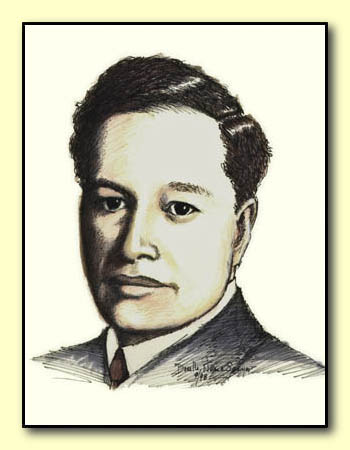
Ernest Kaleihoku Kaai
The first Hawaiian ʻukulele virtuoso, Ernest Kaai, made appearances all over the world. Not only a gifted performer, "Hawaiʻi's Greatest ʻUkulele Player" organized ensembles, composed and published music, and ran the Kaai Ukulele Manufacturing Company. He was undoubtedly the foremost ʻukulele authority of his time and had a profound understanding of the mechanics of playing, for which he published the first ʻukulele instruction book in 1906. Although known for promoting the ʻukulele as a featured instrument in the Hawaiian orchestra, his sophisticated fingering, picking, and stroke styles also inspired the modern establishment of the ʻukulele as a solo instrument.
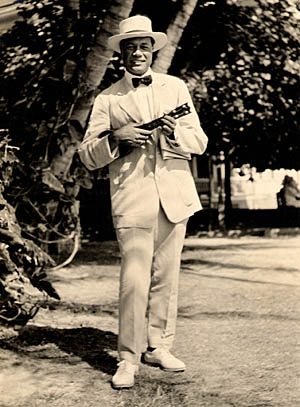
Ernest Kaai, arguably the most influential musical figure in Hawaii in the first quarter of the 20th century, was a gifted performer on many instruments including the mandolin, guitar and ʻukulele. He was also an impresario, teacher, publisher, and recording artist. Known in Honolulu as the "Father of the ʻUkulele," Kaai was said to have been the first musician to play a complete melody with chords.
Kaai wrote the earliest known ʻukulele method, The Ukulele, A Hawaiian Guitar and How to Play It, published in 1906 by Wall, Nichols Co. of Honolulu, with a revised edition published in 1910. The method contains notation conventions, including chord frames, rudimentary tablature, and a hierarchical chord nomenclature that has since become associated with Hawaiian music. It is probable that Kaai invented these notational styles for ʻukulele.
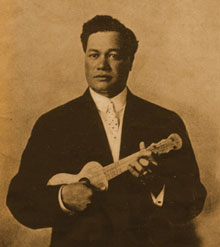
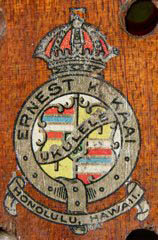
In addition to his musical skills, he also owned the Kaai Ukulele Manufacturing Company, advertised from 1909–1920. Although it was sold in 1917 and Kaai became a shareholder in the newly formed Aloha Ukulele Manufacturing Company, his namesake company apparently continued without reference to whomever was the actual instrument maker in those following years.
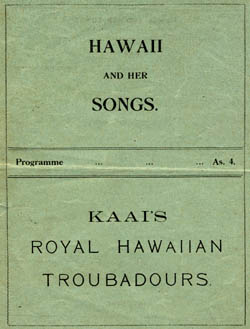
Kaai left Hawaii in 1923 to tour the Far East and Australia, and eventually settled in Sri Lanka. In the mid-1930s, he planned to open a "Hawaiian Village" in Shanghai, China, but the war forced him to flee and he returned to Hawaii in 1937. He moved to Miami, Florida, in 1941 and incorporated the Kaai Music Studios in 1946. He died in Miami in 1962.